
Quick Answer
To become a travel agent in 2026, start by choosing your business model. Next, join a host agency to get your credentials and access to suppliers. Complete your training, register as a seller of travel if your state asks for it, and then book your first trip. You don’t need a degree, license exam, or prior experience. Most people can go from being curious to booking their first client in less than a month. However, the money usually comes in later than most people say, and that’s the most important thing to keep in mind.

What You Don’t Hear About Your First Week
I’m going to start this guide in an unusual place. Instead of paperwork, let’s look at your calendar.
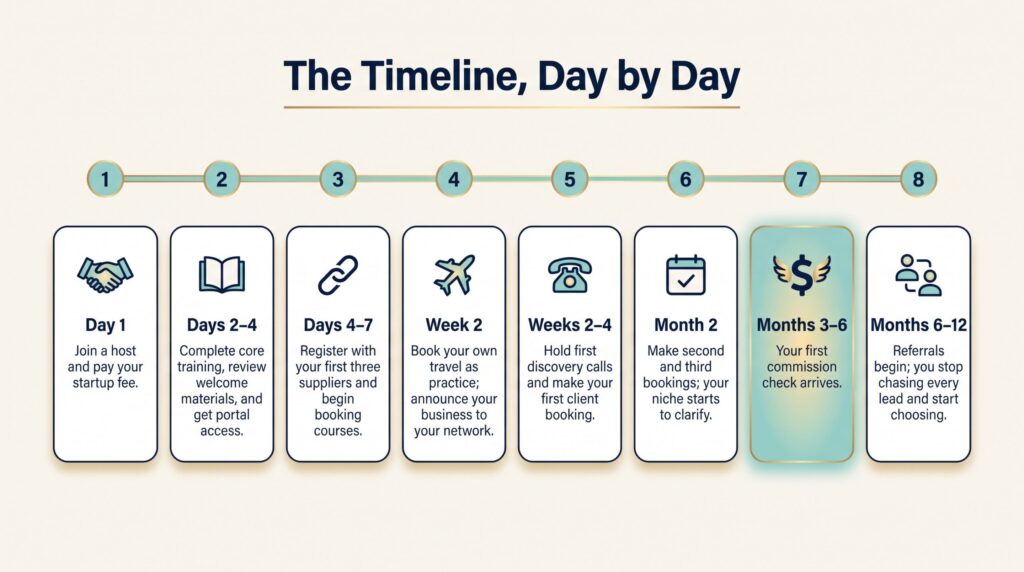
You’ll find plenty of articles explaining how to become a travel agent, and most cover the same basic steps. But they rarely talk about when you actually get paid. You might sign up on a Monday, finish your training by Friday, and book a $6,000 anniversary trip two weeks later. Even then, you won’t see any money until the couple returns from their honeymoon, which could be eight months away.
Most people don’t mention this because it’s not a great selling point. But here’s the truth: you get paid after the trip is over. Once you know that, starting out feels less stressful because you can plan for it instead of worrying about it.
Let’s get started.

Do You Actually Need a License to Sell Travel?
The short answer is no. You don’t need a license at the federal level, and most states don’t require one either.
There’s no national exam, board, or diploma needed. In the U.S., there are no federal rules for selling travel, and no state gives out a personal “travel agent license” like they do for plumbers or real estate agents.
What you do need in some cases is a seller of travel registration. This is a business registration, not a personal license. Here’s what things look like in 2026:
- California — Attorney General registration, roughly $100 per location per year, plus a trust account or bond
- Florida — registration through the Department of Agriculture and Consumer Services, roughly $300 per year, with a surety bond up to $25,000
- Hawaii — DCCA registration on a biennial cycle, roughly $146 to $215, with a client trust account
- Washington — Department of Licensing, roughly $222, with a bond or trust account
- Iowa — registration with the Secretary of State if you’re soliciting Iowa residents
- Maryland — a new seller of travel law takes effect in October 2026, with proof-of-insurance requirements attached
There are two common points of confusion. First, the rules depend on where your clients live, not just your business address. For example, if you’re in Utah but sell a cruise to someone in Florida, you may need to follow Florida’s rules. Second, if you work with a host agency, you’re usually covered by their registration. This can save new advisors thousands of dollars and many hours of paperwork.
Ask your host agency directly, in writing, which state registrations they have and which ones cover you. Don’t just ask if you need a license—request the actual registration numbers and the states they apply to.

The Three Paths (Pick One Before You Spend a Dime)
Every route to becoming a travel advisor comes down to three models. They cost wildly different amounts.
1. Host Agency (Independent Contractor)
You run your own business under an established agency’s accreditation. You get their IATA or CLIA number, supplier relationships, booking tools, training, and commission processing. They keep a slice of your commission. Typical entry cost across the industry runs $99 to $500 to start, with dues from $0 to $99 a month.
2. Franchise
You buy into a branded system. Expect roughly $1,000 to $9,000 upfront plus ongoing royalties. You get name recognition and a playbook. You give up flexibility and a chunk of margin forever.
3. Fully Independent Agency
You get your own accreditation, your own supplier contracts, your own bonding and insurance. A realistic setup runs $2,000 to $18,500 or more, and suppliers want volume history you don’t have yet. This is a year-three move, not a year-one move.
For about 95% of people asking how to become a travel agent, the host agency path is the answer. Not because it’s trendy — because accreditation is a chicken-and-egg problem. You can’t get paid commission without accreditation, and you can’t get accreditation without booking volume. A host solves that on day one.

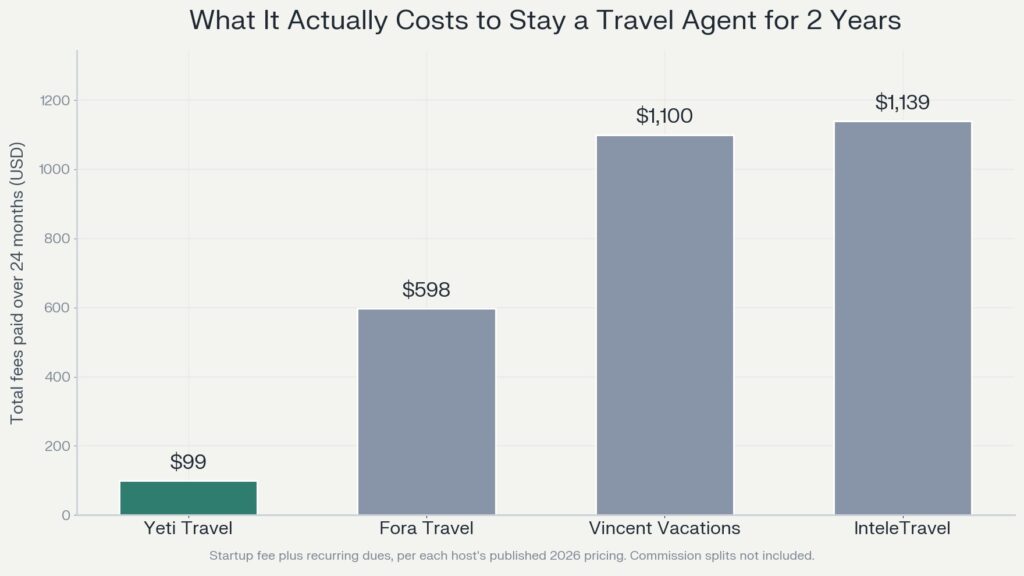
What It Really Costs (The 24-Month Math)
Comparing only the first-year costs can be misleading because monthly fees are often hidden in those numbers.
Instead, here is the total cost for two years, based on each host’s published prices for 2026:
- Business registration or LLC filing: $0 to $500, depending on your state
- Errors and omissions insurance: often included with your host, otherwise $200 to $500 a year
- A domain and simple website: $50 to $300
- Business cards, a decent headshot, a logo — $0 to $250
- Your own travel, for firsthand knowledge: priceless, and you can earn commission on it

How to Become a Travel Agent: The 8-Step Sequence
Step 1: Get Honest About the First Six Months
Step 2: Choose Your Host Agency Like You’re Hiring An Employee
- What’s the total cost over 24 months, including every fee?
- What’s my starting commission split, and what triggers an increase?
- Do you have production minimums? What happens in a slow year?
- Which state seller of travel registrations cover me?
- Who owns my client list if I leave?
- Is there a non-compete, and how long is it?
- What happens to commissions still in the pipeline if I quit?
Step 3: Choose a Niche You Already Know Well
- Theme parks and Disney or Universal family trips: These have a high repeat rate and strong emotional value.
- Cruises: They offer strong commission rates and clear tier bonuses.
- All-inclusive resorts and honeymoons: These come with straightforward commissionable packages.
- Destination weddings and group travel — one client, many bookings
- Multi-stop international itineraries: These trips are complex enough that most people won’t try to plan them on their own.

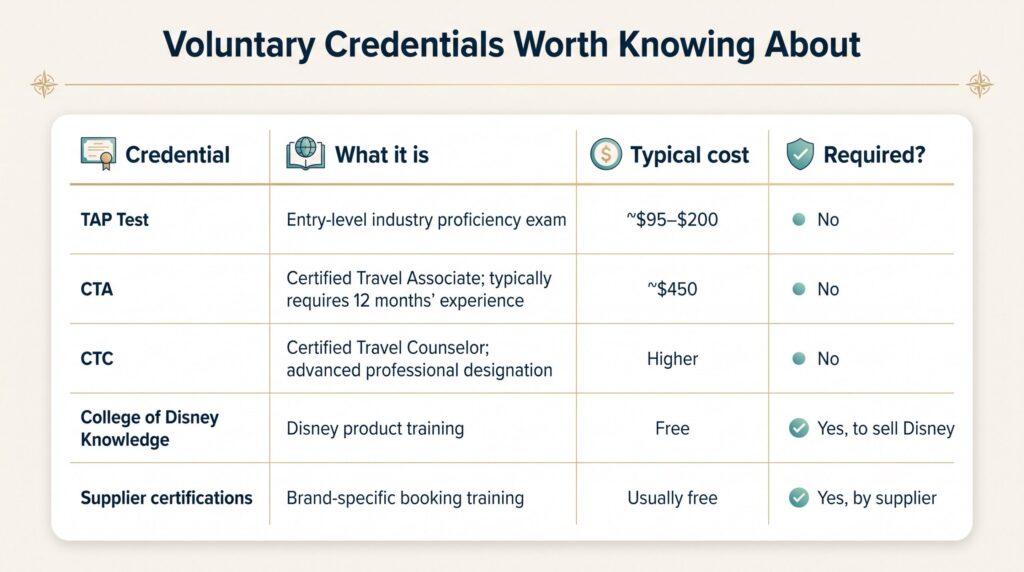
Step 4: Finish Your Core Training, Then One Supplier Course
Step 5: Get the basic setup done in just one afternoon
- Choose your business name and decide if you want to be a sole proprietor or set up an LLC. It’s up to you.
- Get an EIN from the IRS. It’s free and only takes about ten minutes online.
- Open a separate bank account for your business.
- Set up a CRM to track leads, quotes, and follow-ups. Many host agencies include one for you.
- Create a dedicated email address and phone line for your business.
- A one-page intake form so you stop asking clients the same questions twice
Step 6: Try booking your own trip first
Step 7: Get Your First Five Clients From People Who Already Trust You
- Reply to every inquiry within 30 minutes
- Book a 10 to 15 minute discovery call to talk about dates, budget, traveler ages, and must-haves.
- Explain how you work and mention your planning fee, if you have one, before you start any deep research.
- Send just two or three options that you have carefully chosen, not a long list.
- Go over the policies, deposits, and payment deadlines with your client so everything is clear.
- Book it, then send a clean confirmation summary
- Reach out to your client the week before they travel to make sure everything is set.
- Follow up two weeks after your client returns home and ask if they can refer you to others.
Step 8: Track Your Commissions Like a Hawk

What One Booking Actually Pays
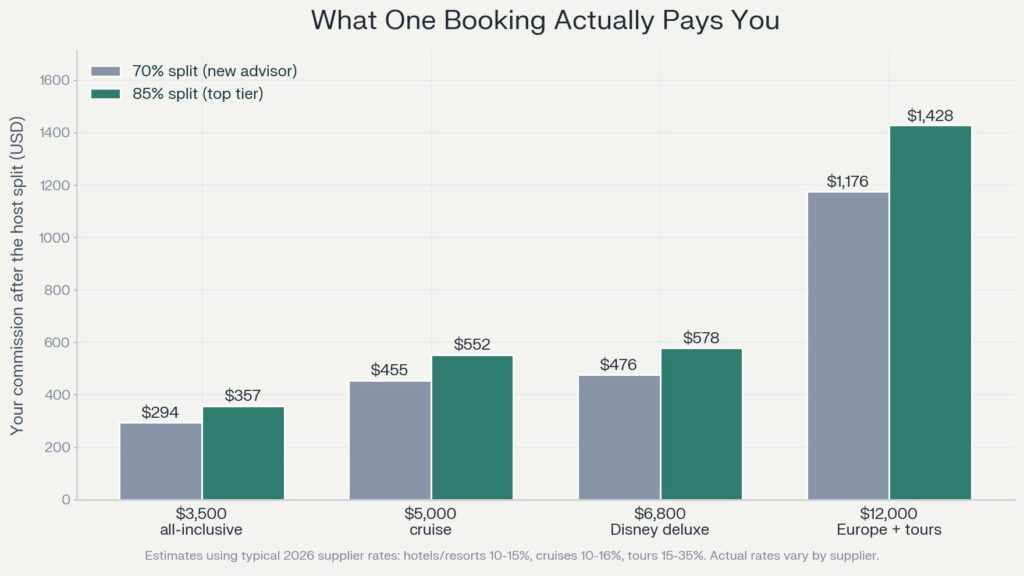
- Hotels and resorts: 10% to 15%
- Cruises: 10% to 16%, with higher rates for more passengers
- Tours and attractions: 15% to 35%
- Car rentals: 5% to 10%
- Domestic airfare: 0% to 5%, but usually close to zero
Travel Agent Sales Commission Calculator
This calculator takes the gross trip sales, applies the supplier commission rate, then shows the agent payout at a 70% commission split.*
Enter the booking total and commission rate.
See the payout update in real time.
Total sales booked
Gross commission
Final commission at 70%
*Estimated commissions are usually based on the travel price before taxes and extra fees. Actual payouts may also be lowered by normal credit card processing, technology, or transaction-related costs.
Travel prices can change because of availability, travel dates, supplier updates, or occasional pricing errors, so the numbers shown here are examples only and are not guaranteed income.
The Timeline, Day by Day

Common Mistakes I See New Advisors Make
- Waiting until you feel ready. The truth is, nobody ever feels completely ready. Go ahead and book the trip.
- Focusing on airfare-only requests. These take hours of work and usually bring in almost no commission.
- Skipping the discovery call and sending quotes without enough information often leads to researching several trips for someone who never planned to book.
- Not charging a fee can turn you into a free concierge for people who are just browsing and unlikely to book.
- Posting deals all the time on Facebook doesn’t attract followers. Instead, share the story behind a trip to engage your audience.
- Signing up with a host agency that charges monthly dues before you know if you enjoy the work can be risky. While you’re learning, slow months shouldn’t cost you anything.
- Failing to track your commissions can leave you confused about where your earnings from previous months have gone.

Frequently Asked Questions
With a host agency, you can get trained and start booking trips in just one to two weeks. While certificate or associate programs take six months to two years, you don’t need them to sell travel.
No, you don’t need a degree, exam, or certification to become a travel advisor in the U.S. To sell certain brands, you’ll need supplier training, which is usually free.
Yes. Most host agencies train people with no experience. What really matters is that you follow through, can write clearly, and are willing to ask questions.
It depends on the company. A real host agency pays you for booking travel. If a company pays you for recruiting other agents, that’s a different kind of business. Ask yourself: do I make money by signing up others? If so, be cautious.
You usually earn about 10% of the booking value as gross commission, after your host agency takes their share. On average, that’s about $438 per booking, but big cruises or long Europe trips can pay much more.
Most of the time, you get paid after your client travels. Hotels usually pay 30 to 45 days after checkout, and cruise lines pay after the final payment. Plan to get your first check about three to six months after you begin.
You only need a seller of travel license if you are in, or selling to people in, California, Florida, Hawaii, Washington, or Iowa. Maryland will require it starting in October 2026. If you work with a host agency, their registration often covers you, but make sure to get that confirmed in writing.
Yes, and it’s a good idea for most people to start part-time. Choose a host agency that doesn’t require production minimums, so you won’t be penalized if you have a slow month.
Yes, with most hosts, and it’s the best possible training. Just book it exactly like a client booking.
There is no real difference. The industry now uses “advisor” to show that the job involves planning and consulting, not just booking tickets. Clients still search for “travel agent,” so both terms are important.
Warm network first, then referrals, then a niche-focused social presence, then local partnerships. Paid ads are the last resort, not the first.
Travel isn’t free, but you do get discounts. FAM trips, agent rates, and CLIA or IATAN benefits offer lower prices so you can experience destinations yourself. Yeti agents keep CLIA benefits by booking at least $500 in travel each year.

One More Thing Before You Sign Up
In 2026, becoming a travel agent is still one of the easiest businesses to start. All you really need is a laptop, internet access, a host agency, and the determination to make ten calls when you’d rather be scrolling.
If I were starting now, I’d look for the simplest and most honest way to see if I really enjoy this work. Don’t worry about the fanciest platform or the biggest name. Focus on the lowest-risk way to find out if you actually like spending forty minutes with a family, helping them turn a vague idea like “somewhere warm in March” into a trip they’ll remember for years.
That’s what the job is all about. The commission comes after you do it well!
If a $99 one-time fee, no monthly dues, no minimums, and a 70% to 85% split sounds like a good way to try this out, that’s exactly why we created Yeti Travel. But if you choose a different company, take the seven questions from Step 2 with you and ask them wherever you go.
No matter what, book your own trip first. I mean it!