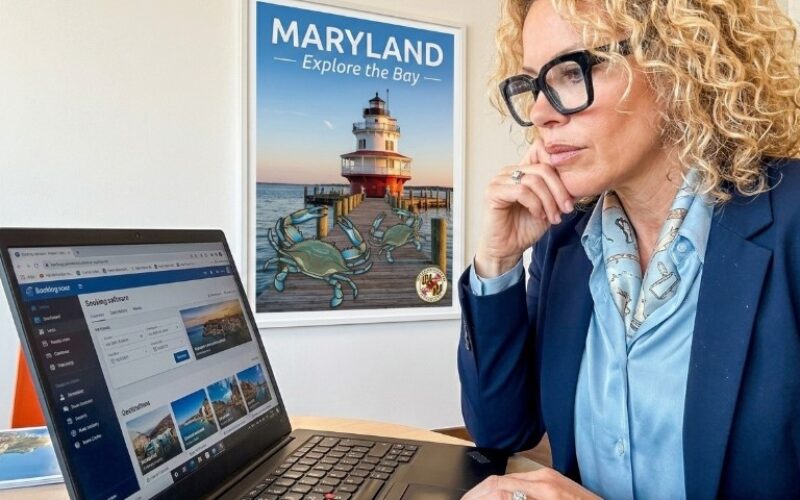
Want to become a travel agent in Maryland?
Good news: Maryland is one of the more beginner-friendly places to start a travel business because you do not need a dedicated state travel agent license, a state licensing exam, formal certification, a bachelor’s degree, or a high school diploma to begin.
Think about it, you are helping clients plan honeymoons, cruises, family vacations, luxury hotel stays, group trips, or resort getaways while building a flexible business that can fit your life.
A Maryland travel agent can work at home, part-time, full-time, or on a flexible schedule, depending on the business model that fits best.
Let us see what the steps towards becoming a travel agent are in Maryland.
Step #1 – Learn Maryland’s Licensing Requirements

Maryland does not require a dedicated travel agent license or state licensing exam.
Maryland’s 2026 HB0994 page lists “Travel Services” regulation, an October 1, 2026, effective date, and a requirement for proof of at least $1,000,000 in professional liability and E&O insurance.
That gives a new travel agent a simpler entry point, since no state travel test has to be passed before booking a client’s travel.
Most new advisors still need access to an IATA number. An IATA number works as an agency identifier that lets a travel agency or advisor make commissionable bookings with suppliers.
Use IATAN CheckACode for the claim that suppliers verify travel agencies and professionals through unique IATA/IATAN codes.
IATAN says CheckACode validates IATA/IATAN accredited entities and travel professionals, and that suppliers such as airlines, hotels, car rental companies, and cruise lines use it when doing business with travel agents.
Suppliers use that number to connect each booking to an agency, including bookings tied to:
- Hotels
- Cruise lines
- Tour operators
- Resorts
- Villas
- Vacation packages
- Car rentals
New agents often gain IATA access through a host agency instead of applying for independent accreditation right away.
That path is usually easier because the host agency already has booking tools, supplier relationships, and agency credentials in place.
Step #2 – Decide to Work Independently or Join a Host Agency
A new Maryland travel agent has two main paths: start independently or join a host agency.
Independent travel agents manage their own clients, marketing, finances, supplier setup, and daily operations.
That path can offer more control, but it also adds responsibility.
An independent advisor may need to handle compliance, payment systems, bookkeeping, supplier access, marketing, and commission tracking without much outside help.
Host-agency travel agents work under a host agency and use its resources.
Planning trips is the fun part, but running the business also means learning about suppliers, payments, commissions, client tools, and compliance.
We believe the right host agency should make that learning curve feel manageable, not overwhelming.
Many beginners choose this path because it can provide key business tools early, including:
- IATA access
- Booking systems
- Supplier programs
- Training
- Marketing support
- Administrative help
- Commission tracking
- Compliance support
Step #3 – Choose the Right Host Agency

Choosing a host agency is one of the biggest decisions you will make as you become a travel agent in Maryland.
A high commission split can look great, but support, training, tools, and fit matter just as much.
We think a host agency should be judged by more than the commission split.
A generous commission structure matters, but it works best when advisors also have the confidence and systems to book correctly.
Compare host agencies using details that directly affect daily work and income potential:
- Commission split
- Startup costs or monthly fees
- Training program
- Supplier partnerships
- Booking platform
- Marketing support
- Mentorship
- Advisor community
- Compliance and paperwork help
- Commission tracking and payment support
Look for a host agency that fits your goals, schedule, budget, niche interests, and learning style.
Step #4 – Get Access to an IATA Number
An IATA number is one of the most important industry credentials for a travel agent.
It allows advisors to conduct business through a travel agency, make commissionable bookings, and help suppliers identify the agency tied to each reservation.
Suppliers use IATA details when processing commissionable travel, especially for bookings such as:
- Hotels
- Cruises
- Tours
- Resorts
- Villas
- Vacation packages
- Transportation
Most travel advisors choose a host agency because the host provides access to its IATA number. For beginners, that is usually easier than applying for independent accreditation immediately.
Without that support, a new independent advisor may face more setup steps before making commissionable bookings.
Those affiliations can support credibility and supplier access, especially for advisors focused on cruises, broader travel planning, or supplier-specific programs.
IATA access is not a Maryland state license. It is an industry credential that helps a Maryland travel agent work professionally with suppliers.
Step #5 – Complete Travel Agent Training

Formal training is not legally required in Maryland, but it is strongly recommended.
Training helps new advisors avoid mistakes, learn supplier rules, and build confidence before handling client trips.
A strong travel agent training program should teach practical skills used in real bookings:
Some training programs include 40+ hours of live, small-group instruction at the initial certification level, plus access to recorded lessons.
Ongoing education may include advanced certifications, partner training, destination training, and supplier updates.
Maryland-based education options can include the Travel Agent Module 1 program at the Community College of Baltimore County and the Hospitality and Tourism Management program at the University of Maryland Eastern Shore.
Good training helps you learn how suppliers think, how commissions work, which client questions to ask, and how to match travelers with the right product.
At Yeti Travel, we do not see training as busywork. We see it as the foundation that helps advisors quote trips, communicate with clients, understand supplier rules, and avoid costly beginner mistakes.
It is the confidence builder that helps you handle sales calls, quotes, booking rules, and client questions with a calm, professional rhythm.
Step #6 – Consider Optional Certifications
Certifications are optional. Maryland does not require them as part of the travel agent license process.
Still, credentials can help a newer advisor build credibility and sharpen expertise.
Certification is common enough in the cruise niche to be a meaningful credibility signal.
CLIA reports that more than 29,000 CLIA certifications have been awarded in North America, indicating that many travel advisors use certification to build cruise-specific knowledge.
Useful certification paths may include:
- Certified Travel Associate
- Certified Travel Counselor
- ASTA-related credentials
- IATA-related certifications
- TAP Test
- CLIA cruise certifications
- Supplier-specific certifications
- Destination specialist programs
Certification can make clients more comfortable booking with a newer advisor. It can also support niche growth, host-agency applications, and supplier confidence.
Cruise-focused advisors may benefit from CLIA programs. Advisors who want broader industry education may consider ASTA-related credentials, IATA-related education, or the TAP Test.
Destination specialists can use supplier and tourism board programs to build stronger product knowledge.
Credentials work best when paired with booking practice, supplier education, sales activity, and strong client communication.
Step #7 – Pick a Travel Niche
View this post on Instagram
A niche helps a new travel agent speak to a clear type of client.
Instead of marketing every trip type to everyone, you can build a message around a specific vacation style, destination category, or client need.
Popular niches for a Maryland travel agent include:
- Luxury travel
- Cruises
- Honeymoons
- Destination weddings
- Disney vacations
- Sandals or resort travel
- Romance travel
- Family travel
- Adventure travel
- Group travel
- Corporate travel
- Maryland-focused travel
Visitor spending in Maryland grew 3.2% in 2024 to $21.2 billion, while visitor volume grew 1.5% year over year to 45.8 million visitors.
Transportation accounted for the largest share of visitor spending at $6.5 billion, or 31%, followed by food and beverage at 25% and lodging at 20%
Romantic travel can include destination weddings, honeymoons, vow renewals, and anniversaries.
Cruise travel may include ocean cruises, river cruises, family cruises, luxury sailings, or group cruises.
Resort-focused advisors may specialize in all-inclusives, Sandals vacations, luxury beach stays, or family-friendly properties.
Some advisors focus only on hotels. Others plan full itineraries that may include:
- Tours and activities
- Transportation
- Villas
- Cruises
- Yacht charters
- Vacation packages
- All-inclusives
- Car rentals
- Travel insurance
- Private aviation
- Room blocks
A niche makes marketing easier because your message can speak directly to the traveler you want to help.
A honeymoon couple, a busy family, a destination wedding group, and a corporate client all need different guidance.
MMGY Travel Intelligence reported that 76% of Americans planned to take a vacation in the next 12 months in its 2024 Portrait of American Travelers research, up from 70% the prior year. It also reported that 64% planned to take a trip in the next six months, up from 58% in October 2023.
MMGY’s 2024 fall travel research showed year-over-year increases in plans to travel for leisure in the next 12 months:
Step #8 – Set Up the Business Side
Business setup gives your travel agency a professional base. Even if you join a host agency, you still need to think like a business owner.
At Yeti Travel, we encourage advisors to create a professional client-facing presence that fits their style, whether that means a simple email address, a social media page, a landing page, or a full website.
Basic setup tasks may include:
- Choose a business name
- Decide on part-time or full-time work
- Create a professional email address
- Set up a business bank account if needed
- Decide on sole proprietor, independent contractor, or LLC status
- Keep clean records for taxes and commissions
- Create client forms, terms, and payment procedures
Many host-agency advisors join as independent contractors. That setup can give advisors room to structure their business around their goals, schedule, and income plans.
A travel agent can often work anywhere with travel passion, Wi-Fi, and a practical attitude.
At-home work is common, especially for advisors using host-agency technology, booking tools, community support, marketing resources, and payment systems.
Some host agencies provide tools that reduce setup work for new advisors:
- Advisor technology
- Partner access
- Marketing tools
- Payment support
- Admin help
- Community apps such as Forum
Maryland and local business registration rules still matter, especially if you form an LLC, accept direct client payments, hire help, or operate under a business name.
A tax professional or business attorney can help you choose the setup that fits your plans.
We Wrote About Surrounding States
| State | What to Know Before You Start |
|---|---|
| Pennsylvania | Focus on business registration, training, supplier access, and the systems needed to manage bookings professionally |
| Delaware | Review business setup, local requirements, professional training, and supplier relationships before launching |
| Virginia | No general travel agent license is typically required, so business setup, training, and supplier access are the main considerations |
| West Virginia | A relatively straightforward entry path, with business registration, training, and booking-system access being the main considerations |
| New Jersey | Review business registration, local requirements, professional training, and supplier relationships before launching |
FAQs
Closing Thoughts
Ready to become a travel agent in Maryland?
Starting can be simpler than many people expect because Maryland does not require a state travel agent license, formal certification, a bachelor’s degree, or a high school diploma.
Success still takes preparation.
Choose your path, get trained, learn the tools, pick a niche, and start building a travel business with confidence.
A Maryland travel agent career can be flexible, practical, and genuinely exciting when you build it with the right support.