
Yeti Travel and Fora Travel aren’t actually competing over commission splits. Both hosts start you at the same 70/30 split, so that headline number is a tie from the beginning. The real differences come down to what you pay each year after joining, how each company tracks your progress, and what happens if you hit a slow period.
One host charges you a single fee and never asks for more. The other charges you every year, but gives you access to a technology platform and a training library that would be very expensive to create on your own.
There isn’t one right answer for everyone. It depends on whether you’re booking a few trips a year for friends and family, or if you want to build a full-time luxury travel business. I’ll break down the real numbers for you.
I want to be clear from the start: I’m affiliated with Yeti Travel. That’s why I’ll point out where Fora comes out ahead, instead of ignoring their strengths. There are several, and a few are important. Make sure to check the latest pricing, contracts, and supplier terms with both hosts before you make any decisions. Things can change.

Yeti Travel vs. Fora Travel at a Glance
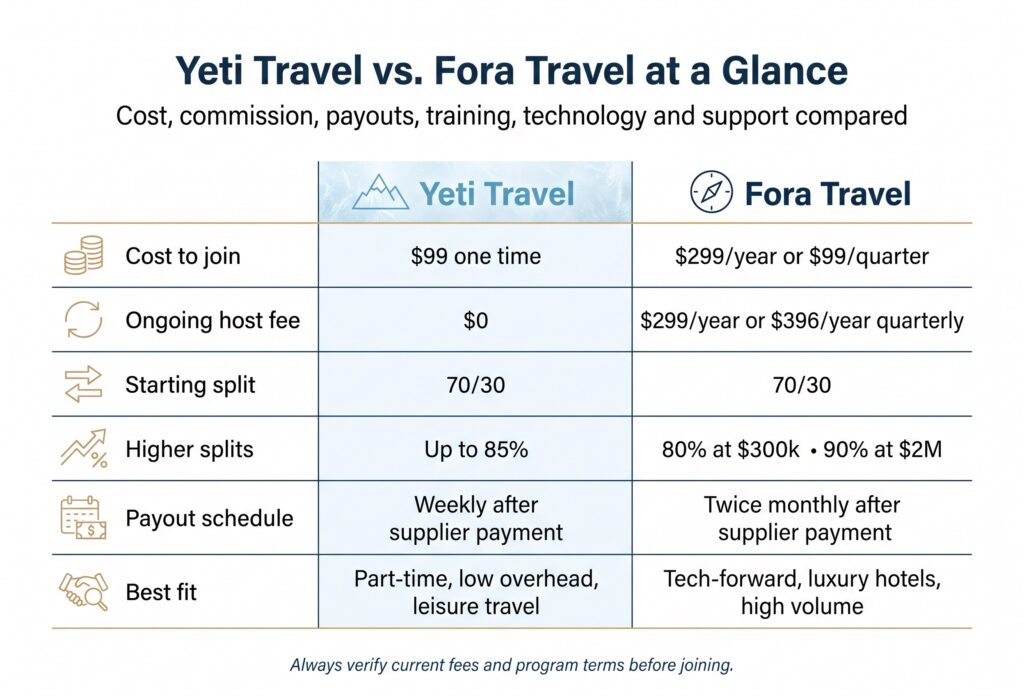
Take a quick look at the table to get the general idea. Next, let’s see how these numbers affect your bank account.

Comparing Costs: One-Time Payment or Annual Fee
Yeti’s Pricing
$99, paid once. Nothing more.
This fee includes supplier registration, errors and omissions insurance, all Yeti training, and a CRM license. You won’t pay monthly fees, annual renewals, or need to meet any quotas to stay active. If you try it out and decide it’s not for you, there’s a 7-day refund window.
What’s not included: a website, branded email address, CLIA card, Florida Seller of Travel registration, or LLC filing. These are optional business expenses, not hidden host fees, but it’s good to be aware of them when planning your budget.
Fora’s Pricing
$299 per year, or $99 every three months. If you pay quarterly, that totals $396 a year, so choosing the yearly plan saves you $97 for the same access.
With this membership, you get access to the Advisor Portal, CRM, tools for building itineraries and proposals, price tracking, automatic commission collection, over 700 training modules, live support, and thousands of preferred hotel partners. It’s a full-featured product, and the price reflects that.e.
The multi-year Math Nobody Puts On the Page
I couldn’t find this comparison table in any ranking article. At first, the price difference seems small, but over time, the gap gets much bigger.
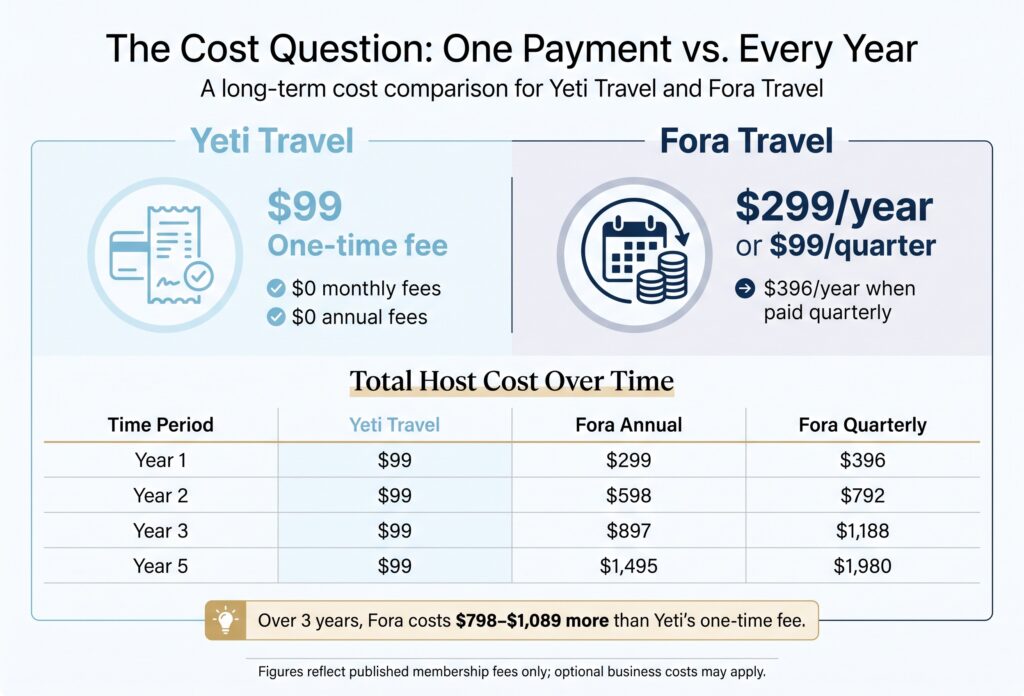
After three years, Fora’s annual plan will have cost you $798 more, and the quarterly plan $1,089 more.
I’m not saying Fora is overpriced. Building software takes resources, and someone has to cover those costs. The real question is whether you’ll get at least $800 of extra value from the platform over three years. If you’re a full-time hotel advisor, that’s likely. If you only book four family cruises a year, probably not.
Your Break-even Number
Here’s the quick version: with a 70% split, a $299 annual fee is about what you’d earn from $427 in gross supplier commission. That’s about the same as one good cruise booking.
So Fora’s fee isn’t huge. It’s simply a bill you get each year, no matter if you booked anything or not.
The Slow-year Test
This is the question I would ask myself before signing up with any company.
Imagine a year when you don’t book anything. Maybe you have a new baby, change jobs, or a parent falls ill. Life happens to everyone at some point.
With Yeti, a quiet year costs you nothing and you keep your access. With Fora, you have to renew to keep using the platform. That’s the main difference between the two models, and it’s why teachers, nurses, and parents of young kids often choose the one-time option.

Yeti Travel vs. Fora Travel Commission Splits: Read the Fine Print
Both companies start you at a 70/30 split. You get 70% of the supplier’s commission, not 70% of the total trip price. This is a key difference that often confuses new advisors.
Here’s a quick example: If your client books a $5,000 resort stay and the resort pays a 10% commission, that’s $500 in gross commission. With a 70/30 split, you would earn $350 and the host would keep $150.
How Yeti’s Ladder Works
Yeti’s published contractor agreement lays out the Summit Plus tiers:
- 75% at $10,000 in total paid commissions
- 80% at $30,000 in total paid commissions
- 85% at $50,000 in total paid commissions
All of these milestones must be reached within one calendar year.
How Fora’s Ladder Works
- 70/30 starting out
- 80/20 at $300,000 in commissionable bookings
- 90/10 at $2 million
The $300,000 threshold resets each calendar year, so you have to reach it again every year.
Here’s the Catch Every Other Comparison Misses
These two commission ladders are measured differently, so comparing them directly without explaining this can be misleading.
Yeti’s $50,000 milestone is based on commissions you have actually received, while Fora’s $300,000 milestone is based on the total amount of travel you have booked.
To compare, if the average supplier rate is 10–12%, then $50,000 in paid commissions equals about $400,000 to $500,000 in booked travel. This means Yeti’s 85% tier is not just slightly below Fora’s 80%—it is actually a much higher requirement, and you also need to enroll in a specific program to access it.
This isn’t meant to criticize either host. It’s just the most important detail to know before you compare these charts, and I want you to be aware of it now rather than discovering it much later.
And the Split Isn’t the Whole Story Anyway
A 70% split with a high supplier rate can be better than an 80% split with a lower rate. Here’s how:
- Host A gets 15% from the hotel, gives you 70% → $5,000 × 15% × 70% = $525
- Host B gets 10% from the hotel, gives you 80% → $5,000 × 10% × 80% = $400
In this example, the split that looks worse actually pays $125 more.
This is Fora’s main advantage. Fora says its advisors average about 12% commission per booking, compared to the industry average of about 10%, mostly because of its preferred hotel agreements. If you book hotels often, this difference adds up quickly and can end up being more valuable than a higher split elsewhere.
Yeti, on the other hand, offers higher supplier rates for other types of travel, such as cruise lines, all-inclusives, Disney, Universal, and package wholesalers through Travel Leaders Network. Each host has different strengths and serves different niches.
So, instead of just looking at the split, consider both the split and the supplier rate for the main brands you plan to sell.
When Does the Money Actually Land?
This surprises almost every new advisor: suppliers pay commission only after your client has traveled, not when they book.
If you book a honeymoon in February for a trip in October, you will probably get paid in November or December.
- Yeti sends payouts every week by direct deposit or check after the supplier’s funds have cleared.
- Fora pays twice a month, usually around the 15th and 30th. Suppliers usually process payments two weeks to three months after the trip ends.
Honestly, the difference between weekly and twice-monthly payouts is just a few days. The real delay comes from the supplier, not the host agency. If you expect a long wait between your first booking and your first deposit, you’ll avoid a lot of stress.

Training and Onboarding: Fast Start vs. Deep Library
Most people focus on commission and overlook training. But eventually, you’ll find yourself looking at a supplier portal with a client waiting for a $7,000 quote, unsure which rate earns commission.
Yeti’s approach
The training is truly self-paced. No one will remind you to finish modules.
You complete Section 1 of Yeti training before signing up with suppliers, then take each supplier’s booking course before selling that brand. Supplier training usually takes two or three days. Some advisors book their first trip in their first week.
You also have access to webinars, Zoom Q&As, group chats, and one-on-one mentoring with someone who knows your name. Audrey helps new advisors from the basics to booking their first trip.
The truth is, self-paced training works best for self-starters. If you need a set schedule and a group to keep you motivated, keep that in mind.
Fora’s approach
Fora offers much more: over 700 on-demand lessons, an Essentials onboarding course, a kickoff call, weekly webinars, live Q&As, in-person sessions, and new-advisor groups. Their pricing page lists more than 28 hours of live training and support each week.
If you learn best by watching, asking questions, and being around others doing the same work, Fora’s library is the best among host agencies. That’s my honest opinion.
One thing people don’t mention is that a huge library can be a way to avoid taking action. I’ve seen new advisors finish forty modules but make no bookings. No matter which host you choose, try to make your first booking early, ideally your own trip, because that’s when you really start learning.

Technology: Fora’s Clearest Win
I’ll let the facts speak for themselves here.
Fora’s Advisor Portal brings together booking, CRM, invoicing, commission tracking, proposals, itineraries, price monitoring, and performance analytics in one platform. You can search over 175,000 hotels, as well as cruises, tours, and activities, and check the commission rate before booking. The system also sends invoices to suppliers automatically and follows up on commissions, so you don’t have to keep track of everything in spreadsheets.
If you book several hotels each week, saving fifteen minutes on each booking can add up to real savings.
Yeti’s tools are more practical than flashy. They offer a CRM license, commission tracking with VAX VacationAccess, booking tools for cruises and hotels, a corporate online booking tool, email and social marketing tools, and various forms and templates. However, there is no custom portal, website, or branded email.
This is a conscious choice. Fora charges an annual fee and invests it in their software, while Yeti keeps costs at $99 by relying on existing supplier tools.
Which is better depends entirely on volume. A beautiful dashboard you open twice a year isn’t a bargain at any price.

Support: Small Team You Know vs. Big Desk That’s Always Open
When you see “support included,” it could mean anything from a searchable help document to a real person who can fix your booking. It’s important to find out which one it is.
Yeti has a four-person team: the founder, an advisor manager, someone for support and marketing, and a brand director. They reply to emails within 24 hours on weekdays. You get real people, not chatbots, and the founder even gives out his own email address.
The good part is you talk to someone who knows your name and understands your situation. The trade-off is that it’s not a 24/7 call center. If you need help late on a Saturday night, you’ll be calling the supplier’s emergency line and making decisions on your own.
Fora gives you live support desks, weekly office hours, a 24/7 online community, WhatsApp groups, local chapters, in-person events, and peer mentorship. If you need a quick answer to something like “has anyone toured this property lately,” having a big community really helps.
These are two different types of help: personal access or a larger support network. Choose the one that fits how you like to solve problems.

The Missing Piece: Consortium Access
Most people who compare these hosts never mention consortiums, but they actually explain supplier rates better than just looking at commission splits.
A consortium is basically a buying group. When your host agency joins one, their combined sales volume helps unlock better commission rates and client perks than a small agency could get on its own.
- Yeti is part of Travel Leaders Network, which is especially strong in cruises, packaged vacations, all-inclusives, and mainstream leisure travel.
- Fora is partnered with Expedia Group and Virtuoso. Virtuoso is the main reason Fora stands out in luxury hotels, offering upgrades, breakfast, and resort credits at top properties.
So the real question isn’t which host is better. It’s which consortium matches the trips you want to sell. For example, a Disney and cruise specialist and a five-star hotel specialist will likely come to very different conclusions after reading this.

Perks and Gatekeeping: FAM Trips, IATA Cards, Leads
FAM trips are often hyped up, but here’s the reality: they’re working trips. You’ll do site inspections, visit several resorts in one afternoon, attend supplier presentations, and usually still have to pay for your own airfare.
Fora only offers its industry perks to agents who reach Pro status, which means $100,000 in annual commissionable bookings, 10 unique clients, and 5 client reviews. Pro status gives you access to FAM trips, a personal IATA card, travel agent rates, preferred partner logins, CLIA membership, and the client leads program. It’s a fair policy, but it’s better to know about it from the start instead of finding out months later.
Yeti includes FAM trips and travel agent benefits in its standard program, and advisors can often bring family members. However, supplier-level eligibility rules still apply, so be sure to check the details.
When it comes to leads, be cautious with both hosts. Yeti does have a lead program and the leads are yours, but they make it clear that most of your business will come from your own network. Fora only offers leads to Pro-level agents. If you’re hoping to just join and wait for clients, neither host will really solve that problem.

Who Yeti Travel Is Best For
- You prefer a one-time payment instead of an annual fee
- You plan to start part-time while balancing another job or family responsibilities
- Your income may vary, and you don’t want a slow year to cost extra
- You focus on selling cruises, Disney, Universal, all-inclusive packages, or family vacations
- You prefer emailing a real person instead of searching through a help center
- You already have a CRM or itinerary tool that works well for you
- You want to get paid weekly and don’t want any sales quotas
- You mainly want to book your own travel and earn commissions on those bookings
Who Fora Travel Is Best For
- You plan to work full-time and want an all-in-one system
- You book hotels often and want to see commission rates before you book
- You specialize in luxury travel and your clients value Virtuoso perks
- You learn best from a huge library plus live sessions
- You want to join local chapters, attend events, and connect with a large peer network
- You expect to book enough that the $299 fee is just a small part of your expenses
- You want a clear and published path to earning 80% and 90% commission rates

Questions to Ask Before You Sign With Either Company
- What’s my total cost in year one, and every year after?
- Are there booking, ticketing, or transaction fees on top of the split?
- Is my split calculated before or after any deductions come off the top?
- What exactly counts toward a higher tier: bookings or paid commissions?
- Does my higher split apply to existing bookings, new ones, or next year?
- What commission tier does the host hold with the five suppliers I’ll sell most?
- Can I charge planning fees, and do I keep 100% of them?
- Who owns my client list, email list, and future bookings if I leave?
- What happens to unpaid commissions after I go?
- What support exists during an after-hours travel emergency?
A good host will answer all of these questions clearly. If you get vague answers, that tells you what you need to know.

Frequently Asked Questions
Is Yeti Travel or Fora Travel cheaper?
Yeti is cheaper both in the short and long run. You pay $99 once for Yeti, with no renewal fees. Fora costs $299 per year or $396 if you pay quarterly. Over three years, you’ll spend about $800 to $1,089 more with Fora.
Yeti is cheaper both in the short and long run. You pay $99 once for Yeti, with no renewal fees. Fora costs $299 per year or $396 if you pay quarterly. Over three years, you’ll spend about $800 to $1,089 more with Fora.
Which has the better commission split?
Both companies start with a 70/30 commission split. Yeti can go up to 85% through its Summit Plus tiers, which are based on paid commissions. Fora offers 80% if you reach $300,000 in bookings and 90% at $2 million. Since each company measures progress differently, it’s best to compare them based on your own expected sales.
Both companies start with a 70/30 commission split. Yeti can go up to 85% through its Summit Plus tiers, which are based on paid commissions. Fora offers 80% if you reach $300,000 in bookings and 90% at $2 million. Since each company measures progress differently, it’s best to compare them based on your own expected sales.
Is Fora Travel worth $299 a year?
If you book travel often, especially hotels, Fora’s platform, preferred partner access, and average 12% commission rate can easily cover the yearly fee. But if you only book a few trips each year, the ongoing cost may not be worth it.
If you book travel often, especially hotels, Fora’s platform, preferred partner access, and average 12% commission rate can easily cover the yearly fee. But if you only book a few trips each year, the ongoing cost may not be worth it.
Is Yeti Travel legit?
Yes. Yeti Travel Co is a host agency based in Utah, founded in 2024. It has CLIA accreditation, is registered as a Seller of Travel in California, Florida, and Washington, is part of the Travel Leaders Network, and has reviews on Host Agency Reviews.
Yes. Yeti Travel Co is a host agency based in Utah, founded in 2024. It has CLIA accreditation, is registered as a Seller of Travel in California, Florida, and Washington, is part of the Travel Leaders Network, and has reviews on Host Agency Reviews.
Is either one an MLM?
No. Neither pays you for recruiting. There’s no downline and no sponsor requirement at either host — income comes from selling travel. That’s the single clearest line between a real host agency and a travel MLM.
No. Neither pays you for recruiting. There’s no downline and no sponsor requirement at either host — income comes from selling travel. That’s the single clearest line between a real host agency and a travel MLM.
Can I earn commission on my own vacations?
Yes, at both. Yeti actively encourages it and calls it the best way to learn the booking process. Just note that some advisor rates and deeply discounted offers aren’t commissionable.
Yes, at both. Yeti actively encourages it and calls it the best way to learn the booking process. Just note that some advisor rates and deeply discounted offers aren’t commissionable.
How fast can I start booking?
With Yeti, you can start booking after you finish Section 1 and your supplier’s course, which usually takes two to three days. With Fora, many advisors start booking within two weeks, or even sooner if they already have a traveler ready.
With Yeti, you can start booking after you finish Section 1 and your supplier’s course, which usually takes two to three days. With Fora, many advisors start booking within two weeks, or even sooner if they already have a traveler ready.
Do either require minimum sales?
Neither requires minimums to stay active. Yeti does ask for $500 in booked travel annually to keep CLIA benefits, which one family trip covers. Sales thresholds only apply to higher splits and perks.
Neither requires minimums to stay active. Yeti does ask for $500 in booked travel annually to keep CLIA benefits, which one family trip covers. Sales thresholds only apply to higher splits and perks.

Final Thoughts
Choosing between Yeti Travel and Fora Travel really comes down to one question: do you want to protect your cash flow, or are you looking to invest in infrastructure?
Choose Yeti if you want to keep things simple and affordable. You pay $99 once, get a 70% commission split from the start, receive weekly deposits, and E&O is included. There are no quotas, and you don’t owe anything if business is slow. Yeti is perfect for someone who’s been considering this for a while and wants a low-risk way to get started.
Pick Fora if you’re ready to treat this as a full-time business and plan to use all the platform’s features. The portal is top-notch, the training library stands out, and the Virtuoso access is real. The average 12% commission rate is a strong selling point. Just be sure your sales volume makes the yearly fee worth it before you sign up.
After years in this industry, here’s what I really think: your choice of host agency matters less than simply telling people what you do. The most successful advisors aren’t the ones with the best commission split. They’re the ones who made a list of fifty travelers and actually contacted them.
Choose the host agency whose costs and support match how you plan to work on a regular day. Then focus on getting your first booking. That’s when your business truly begins!