Host agency red flags rarely show up in obvious ways. You won’t get a message saying, “Hey, want to join my downline?” Instead, you’ll see a sunset, a laptop by the pool, or a screenshot of a commission check with an impressive number.
Here’s the tricky part: what really sets a real host agency apart from a travel MLM isn’t the fee, the ID card, or the excitement. The difference is much more subtle and hidden in how the company makes its money. Once you notice it, you can’t ignore it, and you’ll spot it quickly on any opportunity call.
I’ve seen smart people overlook this. A teacher I know paid to join what she thought was a work-from-home travel job. She got a login, a badge, and joined a group chat that felt like a pep rally every night at 9 p.m. After eleven months, she had booked just one trip—her own family’s Universal week—paid dues the whole time, and ended up with an awkward relationship with a neighbor she had recruited at church.
You can avoid that. Let’s go through how.
What a Host Agency Actually Does
A host agency provides the back-office support that independent travel advisors need. You focus on selling trips, while they take care of everything behind the scenes.
This support usually covers:
Industry accreditation you book under (ARC, IATA, CLIA)
Booking technology, a CRM, and commission tracking
Errors and omissions insurance
Seller of travel compliance in states that require it
Real training on destinations, suppliers, and service
A human who answers when a client’s ship changes ports on a Friday
In return, you may pay a startup fee, a monthly or yearly membership, and share a portion of your commissions. This is standard, since accreditation, insurance, accounting, and support all have real costs.
So paying a host agency is not the issue. It never has been.
What a Travel MLM Sells Instead
A travel MLM is really a recruiting compensation plan disguised as a travel business. Participants can earn money in two ways: by selling trips, and by signing up others who also pay to join. These new recruits become your “downline,” and in most plans, the people above them get a share of what comes in.
Host Agency Reviews explains the difference clearly: host agencies only make money when you sell travel, while travel MLMs earn more from selling memberships.
That’s the main point.
It’s important to be clear, since many blog posts mix this up: an MLM is not automatically an illegal pyramid scheme. The FTC’s long-standing test checks if rewards come from real sales to real customers or from recruiting people into the program. Many travel MLMs are legal. But being legal and making a good living are two very different things.
The one-sentence test
A real host agency helps you earn money by booking travel for clients. A travel MLM, on the other hand, needs you to sign up new people. If you can make a real income without recruiting anyone, it’s likely a host agency. If you only make money by building a team under you, it’s not.
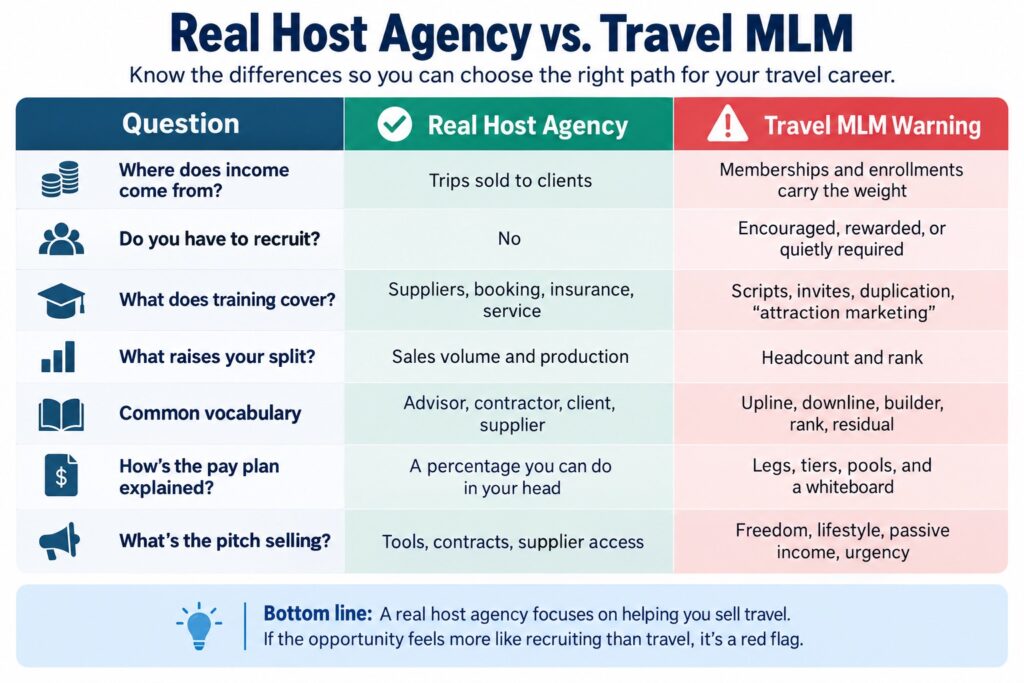
Host Agency vs. Travel MLM at a Glance
A single example doesn’t mean much. It’s the patterns that really matter.
The 12 Host Agency Red Flags You Shouldn’t Ignore
1. Recruiting gets more airtime than booking
Time the presentation. Seriously, just open the stopwatch on your phone.
How many minutes go to finding clients, quoting a cruise, handling a cancellation, understanding travel insurance? Now how many go to inviting people, building a team, “duplicating yourself,” and hitting the next rank?
If recruiting takes up most of the time, then travel is just there for show.
2. Your first assignment is a list of friends and family
A real host agency helps you choose a specialty and create a marketing plan. A recruiting scheme just gives you a notebook and tells you to list everyone you know.
It’s normal to tell your friends and family about your new business. Every entrepreneur does that. The problem is when those people are seen as people to sign up, not as clients to help. If your first week is all about inviting ten friends to a call, you’re not learning to be a travel agent. You’re learning to recruit.
3. The compensation plan needs a whiteboard
Binary legs. Matching bonuses. Generational overrides. Personal volume versus group volume. Leadership pools.
Everyone nods. Almost nobody could calculate their actual paycheck.
Compare that to a normal travel commission: a supplier pays the agency $500, your written split is 80%, you get $400 before fees. Done. No diagrams, no motivational music.
4. “Passive income” is the headline
Travel advising has a lot of great qualities, but being passive isn’t one of them.
The job involves research, giving quotes, following up, sending payment reminders, making last-minute schedule changes, and helping clients when their flights get canceled. If someone promises you’ll earn money while you sleep, ask where that money really comes from. Is it from happy clients who keep coming back, or from new members joining under you?
5. You can’t join without a sponsor
This is the modern version of the trap, and most guides don’t talk about it.
Some companies really do have booking tools and supplier deals. But if the only way to join is through a network marketing partner, your monthly fee gets divided among people who never trained you, never booked anything for you, and won’t help when a client has a problem.
If you can’t apply directly on the company’s website without using someone’s referral link, that’s a major warning sign in this industry.
6. The income screenshots have no context
Big numbers are easy to post. Ask the boring questions instead:
Gross or net?
One month or one year?
Travel commission or recruiting bonus?
What did that person spend to earn it?
How many participants earned nothing?
The FTC analyzed 70 publicly available MLM income disclosures and found most participants made $1,000 or less a year — often before expenses. In at least 17 of those companies, most participants made nothing at all. The agency also documented the pattern: spotlight the handful of high earners, downplay the zeros, ignore expenses.
A photo of someone on a yacht shows what happened to one person. It doesn’t tell you what’s normal for most people.
7. Free travel is often advertised as the main benefit
“Join and travel for practically nothing!” This kind of pitch has been used by card mills since the 1990s.
There’s something those videos don’t tell you. To get an IATA/IATAN ID card, you must work at an accredited agency, be listed as staff, work at least 20 hours a week in travel sales, and earn at least $5,000 in salary or commissions in the past year.
Remember, that’s $5,000 earned—not just $5,000 in trip sales. Many new agents confuse the two and end up disappointed. Special rates and FAM trips depend on your sales and relationships, not just having a badge you bought recently.
Ask yourself: Would you still join if the personal discounts disappeared tomorrow? If not, you’re looking for a travel club, not starting a business.
8. Extra fees often appear after you sign up
A trustworthy host agency is straightforward about money. All costs should be clearly listed in writing before you start.
Look out for extra charges like platform fees, CRM add-ons, website subscriptions, training upgrades, marketing kits, and conference tickets that become required if you want to keep your rank, as well as renewal and payout processing fees.
Ask for a written estimate of your total first-year costs, not just the monthly fee they advertise. Then calculate how much travel you’d need to sell to break even.
Knowing that number can help you make a clear decision.
9. Training often focuses on recruiting, not the actual travel products
Take a look at the actual course library.
Good beginner training should cover supplier portals, quoting, client intake, travel insurance and waivers, documentation, service fees, cancellations, and fraud prevention. Poor training just teaches DM scripts, matching graphics, and how to run a recruiting event.
I once met a new recruit who knew every rank in the compensation plan but couldn’t explain what a cancel-for-any-reason waiver was. That’s not a travel advisor—that’s just someone selling a program.
10. The language they use can be a giveaway
One buzzword isn’t a big deal, but hearing several together should make you pay attention.
Words like downline, upline, builder, duplication, residual, legacy income, team volume, ground floor, financial freedom, and phrases like “find two who find two” are common in these pitches.
Real travel professionals talk about clients, suppliers, commission splits, tracking commissions, consortia, and ongoing education. The words people use show what they really value.
11. Asking questions is often seen as being negative
You should be able to ask hard things without being called fearful or “not coachable.”
Be careful if you hear things like, “critics just didn’t work hard enough,” “doing research will only confuse you,” or “skeptical family members are holding you back.” A real business can handle questions, contract reviews, and a simple Google search.
The FTC recommends having someone who isn’t connected to the company review the paperwork before you pay. If a company resists this, that’s a warning sign.
12. Leaving can be much harder than joining
Signing up takes four minutes. Leaving shouldn’t feel like escaping a maze.
Before you join, ask what happens to bookings that take place six months after you leave. Who handles changes? Who gets the commission? Is there a notice period, auto-renewal, or a termination fee?
Make sure you get these answers in the official agreement, not just in a text message.
Why Travel Is a Terrible Product for an MLM
Most articles on this topic leave out a key point, but this is the one that should really answer the question for you.
Multi-level marketing only works when four things come together: a big profit margin, an easy sale, quick delivery, and fast payment. Products like lipstick, leggings, and supplements always check all four boxes.
Travel fails all four.
The profit margins are thin. Suppliers pay about 10 to 20 percent on hotels, tours, and cruise cabins, and the host takes its share before you get paid. One booking just doesn’t make enough money to support a chain of uplines.
It’s a tough sale. Even booking a basic hotel room requires real know-how. Someone new with just a starter kit usually doesn’t have that knowledge and probably won’t learn it quickly.
Fulfillment is slow. If you book a cruise today, it might not set sail for over a year, and there could be changes or cancellations before then.
Payment is also slow. You often get your commission only after the trip is over, which is a headache for any business model that relies on quick payouts.
That’s why so many travel MLMs depend on monthly fees and sign-up bonuses. They need these because the travel sales alone can’t support the compensation plan.
So the sales pitch becomes all about the feeling: free trips, being your own boss, working by the pool with a drink nearby. It sounds like a dream, but in reality, the business model is more like a subscription service.
Contract Traps That Have Nothing to Do with MLMs
Even a reputable host can give you a tough contract. Read it carefully, because it could put your clients at risk.
Look for these things in the contract:
Commission forfeiture on exit. “All unpaid commissions are forfeited upon termination” turns your own money into a leash.
Unilateral changes. If the host can adjust splits or add fees at any time, you don’t have a contract. You have a subscription they control.
Host claims ownership of clients. The clients you found and built relationships with should stay with you. If the host gave you a lead they purchased, that’s different, but otherwise, your clients should remain yours.
Long non-compete clauses. If the contract says you can’t work for a competitor or start your own agency for a year or more, you should look at that very carefully.
Non-disparagement with penalties. You should be able to describe your experience honestly.
Here’s a helpful tip agents are using: copy the whole agreement into an AI tool and ask it to highlight any unfair or harsh clauses for independent contractors. Then, search for words like “forfeit,” “sole discretion,” “non-compete,” “modify,” and “terminate.” If something makes you uneasy, trust your instincts.
Three Questions That Make a Fake Host Squirm
Forget about the compensation chart for now. Ask these questions instead, and make sure to write down what you hear.
1. Can I earn a full income here without ever recruiting anyone?
A real host will say yes without hesitation. You’ll still need to work hard at selling and marketing, but recruiting should not be the main focus.
2. What percentage of company revenue comes from travel commissions versus enrollment fees and dues?
The rep may not know, and that’s fair. The company should be willing to explain its model. If every answer loops back to “unlimited potential,” you didn’t get an answer. For historical context: when YTB collapsed, roughly 85% of its revenue came from memberships and marketing materials — not travel. The California Attorney General shut it down as an illegal pyramid scheme in 2009.
3. Does my commission split rise with sales volume, or with the number of people under me?
If your commission grows with sales volume, that’s a real business. If it grows with headcount, that’s a pyramid. This simple question can save you hours of research.
Green Flags: What a Healthy Host Looks Like
Steering clear of a bad fit is just the first step. Here’s what to look for in a great host:
Income comes from bookings and planning fees, full stop
Recruiting is absent from the compensation plan entirely
Every fee is listed like a menu, not a mystery box
You can stay a one-person shop forever and still be welcome
Nobody rushes you
To be honest, the best hosts might seem a bit boring during the sales call. That’s actually a good sign. It means they’ve already been clear about the money side of things.
Already Joined? Here’s Your Exit Ramp
Don’t panic. Many smart people join before they fully understand how things work. High-pressure recruiting is effective because it mixes trust, hope, and a sense of community.
Do this in order:
Stop recruiting until you understand the model.
Download your agreement, compensation plan, and payment history.
Add up everything you’ve spent, including “optional” stuff.
Separate travel commission from recruiting income. Look at that ratio honestly.
Read the termination section twice and calendar any notice period.
Export any client data you legally control.
Ask in writing what commissions remain due and when they pay.
Compare two or three real hosts on split, fees, support hours, and exit terms.
If you paid based on income claims that turned out to be fantasy, keep records and report it at ReportFraud.ftc.gov.
One rule above all: don’t recruit more people to recover what you spent. That just converts your financial pressure into someone else’s.
Extras Worth Knowing
Work-from-home travel is a real job. Thousands of independent advisors do this every day. It involves sales, service, and ongoing learning. It is not a get-rich-quick scheme.
Seller of travel isn’t a vibe. Some states regulate who can collect client funds. California requires sellers of travel to register and display the number in advertising; Florida has its own registration and bond requirements. Many advisors operate under their host’s registration, but ask how yours handles it before you take a deposit.
You do not need your own accreditation when you start. ARC, IATA, and CLIA requirements are tough for new solo advisors. That is why host agencies exist.
Specialists are valued for their experience. Families pay for someone who has actually visited that theme park in the summer and knows which resort is best. You cannot learn this from a starter kit.
Frequently Asked Questions
How can I tell if a travel agency is an MLM?
See if anyone is making money from people they recruit, and from those recruits as well. If the focus is more on building a team than actually booking travel, it’s probably a travel MLM.
Are host agencies pyramid schemes?
No. A traditional host agency gives independent advisors the tools they need to sell travel and only earns money when those advisors make sales. A pyramid scheme is different because most of the rewards come from recruiting people, not from real sales to customers.
Are travel MLMs illegal?
Not always. Some network marketing companies are legal. Illegal pyramid schemes are a smaller group. The FTC looks at whether money comes from real sales to customers or just from signing up new people.
Does a monthly fee mean it’s an MLM?
No. Many real host agencies charge monthly or yearly fees for things like technology, insurance, training, and support. What matters is what you get for the fee and if anyone is paid for bringing you in.
What’s a card mill?
A card mill is a company that sells the look of being a travel agent, usually by giving out ID cards and promising discounts, but they don’t teach you how to help real clients. Travel suppliers have avoided them for years.
Do travel agents really get free travel?
Reduced-rate travel and FAM trips exist, but they’re earned through production and supplier relationships. They aren’t a signup bonus. IATAN eligibility alone requires 20 hours a week and $5,000 in earnings.
What’s a fair commission split?
A 70/30 split in your favor is a common starting point, and you can earn more as you book more trips. But the highest percentage isn’t always the best. An 80% split with poor support is worse than a 70% split with good training and supplier connections.
Who owns my clients if I leave a host agency?
It all depends on your contract. Some host agencies let you keep the clients you brought in, while others claim all bookings made under their name. Make sure you get this in writing before you sign anything.
What happens to my pending commissions when I leave?
Your agreement should spell out whether they’re paid, who services active bookings, and what gets deducted. Never assume you’ll be paid automatically after termination.
Can I become a travel agent without recruiting anyone?
Yes, you can. Most professional travel advisors never have to recruit anyone. If a company says you need to build a team, that’s a sign it’s an MLM.
How do I research a host before joining?
Look at independent review sites, your state attorney general’s complaint records, the company’s accreditation, and its leadership background. Also, try to talk to a current advisor who wasn’t chosen by the recruiter.
Why do people still join travel MLMs?
It’s because the photos are convincing. When you’re tired of your job and love to travel, hope can be strong. The fee seems small, the community feels welcoming, and the bill doesn’t seem urgent.
One Sticky Note Before You Pay Anyone
Before your next opportunity call, write this sentence and put it on your monitor:
“I get paid when travelers take trips I planned.”
If the person on the call can’t show you how to build a business based on that sentence, it’s not a real host agency. It’s just a membership with palm trees in the advertisement.
Host agency red flags aren’t meant to make you doubt this industry. Being a travel advisor is a great career—it’s flexible, creative, and you get to help people make lasting memories. These warnings are here to help protect your money, your friendships, and your future clients.
Choose a host agency that is straightforward about commissions. Then focus on becoming great at travel—that’s where the real fun begins!