
Is becoming a travel agent worth it? Yes, for the right person, it really is! But it’s probably not for the reasons those Facebook ads keep shouting at you.
Here’s what surprised me when I looked into the real numbers. One working advisor put it simply: only about 10% of the job is actually planning trips. The other 90% is marketing, chasing leads, bookkeeping, supplier training, and handling emergencies late on a Saturday night.
And yet demand has never looked better. Half of travelers now say they’re more likely to book with an advisor than they used to be, and 68% say planning a trip feels more complicated than ever.
So this is a career with plenty of opportunity, low startup costs, and work that’s very different from what you might expect. Let’s look at what that really means for your finances, your schedule, and your first year.

What the Job Really Looks Like Day to Day
Don’t picture someone just printing airline tickets at a desk. These days, you’re a consultant, a project manager, and a small-business owner all at once.
Here’s what a typical week actually looks like:
* You’ll have discovery calls to find out what a family really wants, not just what they say they want.
* You’ll spend time researching resorts, cruise ships, destinations, and tour operators.
* Instead of sending a long list of links, you’ll put together two or three carefully chosen options.
* Tracking final payment deadlines, passport names, and insurance offers
* You’ll post helpful content online so new people can find you.
* You’ll answer the phone when a client’s connecting flight gets canceled in Atlanta.
* You’ll explain cancellation policies and payment schedules to your clients.
* After your clients travel, you’ll follow up to ask for reviews and referrals.
To be honest, booking trips is the easy part. Building relationships is what really matters in this business.
Today’s travel agents do much more than just book flights and hotels. You help people sort through confusing choices, avoid expensive mistakes, make confident decisions, and stay calm when plans go wrong.
That’s why this job is still important!

Is Becoming a Travel Agent Worth It Financially?
Is becoming a travel agent worth it financially? It can be, but it’s important to know the difference between the total value of trips you sell and what you actually take home.
If a client books an $8,000 vacation with you, you don’t earn the full $8,000. You only get a percentage of the commissionable parts of the booking, and you might also need to share that commission with your host agency.
Employed travel agents had a median annual wage of about $50,160 in 2025, with top earners making over $76,000. Independent travel advisors can make less or more, depending on their specialty, sales, clients, fees, experience, and how commissions are split.
New hosted travel advisors usually earn much less in their first few years. They are still learning, building a client base, and waiting for commissions to come in. One industry survey found that hosted advisors with less than three years of experience made about $12,057 a year, while those across all experience levels averaged about $52,636.
This difference is important to keep in mind.
Your first year may be slow. Your long-term potential can be much stronger if you build a clear niche, earn repeat clients, get referrals, charge planning fees, and book higher-value trips.
Travel Agent Income by Career Stage
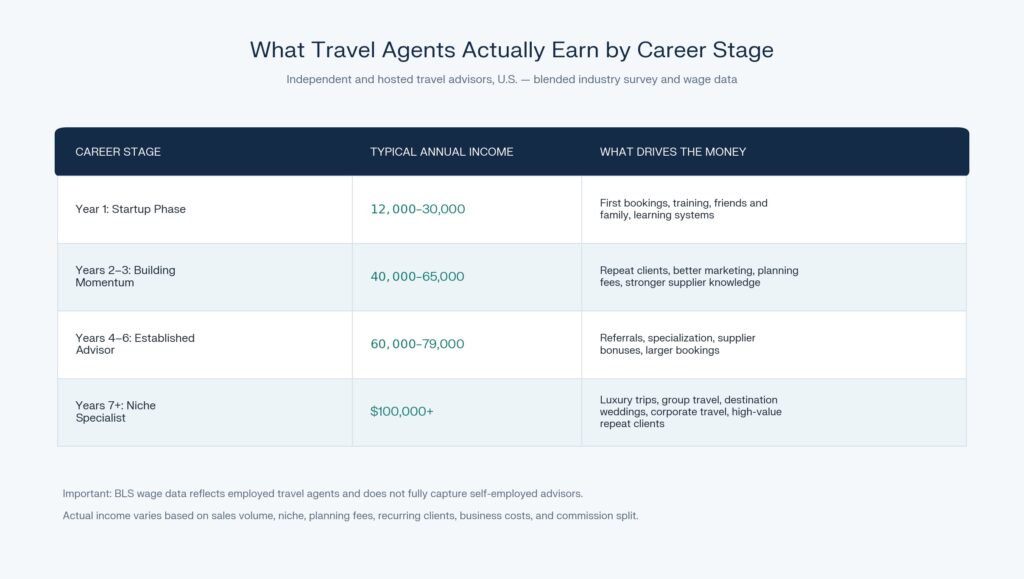
These numbers are not guarantees. They simply show how income can typically increase as time goes on.
Top agents usually focus on a specific area instead of trying to do everything for everyone. They build a reputation for their specialty.
For example, an advisor who focuses on Disney vacations, cruises, destination weddings, luxury trips to Europe, or all-inclusive Caribbean resorts can offer more value than someone who just says, “I book travel.”

How Travel Agent Commissions Work
Most travel advisors make money from supplier commissions. Hotels, cruise lines, tour operators, resorts, insurance companies, and other travel suppliers may pay a commission when you book a qualifying trip.
The commission amount depends on the supplier, the type of product, your sales volume, and your relationship with your host agency.
Here are some typical commission ranges:
- Cruises: Usually between 10% and 16%
- All-inclusive Resorts and Hotel Packages: Typically 10% to 15%
- Hotels: Often 5% to 10%, and sometimes higher if you have preferred programs or high sales volume
- Guided Tours and Activities: Usually 10% to 20%, and sometimes even higher
- Flights: There is usually little or no base commission
Let’s look at a simple example.
- Suppose you book a $5,000 cruise for a client.
- The supplier pays a 12% commission.
- That means you earn a total commission of $600.
- Your host agency gives you an 80% split.
- So your share is $480 before you subtract business costs and taxes.
That $480 may sound good, but remember what goes into one booking:
- Discovery calls
- Research
- Proposals
- Revisions
- Booking paperwork
- Payments
- Supplier follow-up
- Final documents
- Support before and during travel
- Post-trip follow-up
This is why successful travel advisors pay attention to profit per booking, not just total sales.

The Commission Lag Nobody Warns You About
This is one of the main reasons why new agents often feel frustrated.
Most of the time, you do not get paid when a client books a trip. In many cases, payment comes only after the client has traveled. Depending on the supplier, you might not see your commission until weeks or even months after the trip is over.
For example, imagine you book a honeymoon in January, but the couple is not traveling until November.
You could spend months answering questions, tracking payments, sending documents, and helping the couple get ready. Your commission might not show up until December or even January.
That is quite a long wait.
Build a Cash-Flow Calendar
One of the best things you can do is set up a cash-flow calendar instead of relying only on a sales tracker.
For every booking, record:
- Client travel date
- Total booking amount
- Commissionable amount
- Expected supplier commission
- Your commission split
- Estimated payment date
- Planning fees already collected
- Possible cancellation risk
This helps you avoid ‘paper success,’ where your sales numbers look great, but your bank account does not reflect it.

The Cost to Become a Travel Agent
One reason many people find becoming a travel agent worthwhile is the relatively low startup cost.
You do not need a storefront, inventory, or a four-year degree to get started.
A realistic first-year budget through a host agency may include:
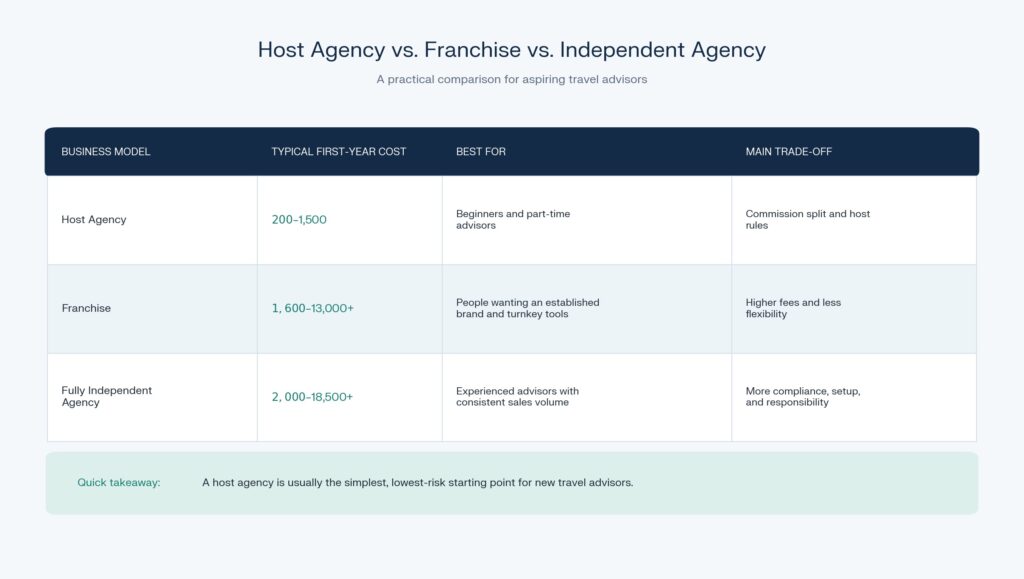
- Host agency fees: $200 to $2,000 per year
- Training and certification: $200 to $1,000
- Errors and omissions insurance: $300 to $500
- CRM and booking tools: $0 to $2,500
- Website, branding, and marketing: $300 to $3,000 or more
- Business registration, accounting, and bank fees: Varies by location
Many people can start for about $500 to $2,500. Most hosted advisors spend around $1,500, depending on their host agency, technology, training, and marketing choices.
This is much less expensive than opening a restaurant, retail shop, franchise, or other traditional business.

Do You Need a Travel Agent License?
There isn’t a nationwide travel agent license in the United States.
But you might need to register your business or follow seller-of-travel rules, depending on your location, your business address, and where your clients are.
The states that usually require seller-of-travel registration are:
- California
- Florida
- Hawaii
- Washington
Maryland has also passed a seller-of-travel law that will start in October 2026.
Rules can change, and things may be different if you sell travel in more than one state. Before you start, check the latest requirements with state agencies or talk to a legal or tax expert.
Do You Need Travel Agent Certification?
You usually don’t need certification by law, but it can be helpful.
Training helps you learn about supplier rules, customer service, travel insurance, destinations, sales, and booking tools. It can also make you feel more confident when clients ask new questions.
Common industry credentials include:
- Travel advisor training through a host agency
- The Travel Institute programs
- Cruise Lines International Association, often called CLIA
- Supplier training programs from cruise lines, resorts, tour operators, and theme parks
- IATA or ARC-related credentials, usually handled through a host agency for new advisors
You don’t have to know every destination before you start. What matters is being willing to learn, double-check facts, and never guess when a client’s vacation money is at stake.

Host Agency vs. Franchise vs. Independent Agency
Many new travel advisors choose to start with a host agency. This option is usually the simplest and safest way to get started.
Why Most New Advisors Pick a Host Agency
A host agency offers several benefits, including:
- Access to supplier relationships
- Booking technology
- Training and mentorship
- A commission-processing system
- Industry credentials
- Preferred supplier rates and promotions
- Errors and omissions insurance options
- Community support from other advisors
- Marketing resources and templates
In return, you might pay a yearly or monthly fee, share commissions, or sometimes both.
A high commission split isn’t the only thing to look for. A 90/10 split might seem appealing at first, but it can be disappointing if there’s not enough training, support, or good technology, and no one helps when you have a client issue.
Sometimes, an 80/20 split with great support can help you earn more over time!
Before choosing a host agency, be sure to compare:
- Startup and monthly fees
- Commission split
- Training quality
- Supplier relationships
- Technology and CRM tools
- Website and branding options
- Client ownership policies
- Exit terms
- Errors and omissions insurance
- Support availability
- Commission payment schedule

The Biggest Benefits of Becoming a Travel Agent
You Can Work From Home
A lot of travel advisors work from home, whether that means a home office, the kitchen table, a spare bedroom, or even their laptop while on the road.
This kind of flexibility appeals to parents, retirees, people changing careers, military spouses, and anyone who wants to build a business that fits their life.
However, being flexible does not mean you have no responsibilities. If a client’s flight gets canceled, they will still need your help, even if it’s Sunday night. It’s important to set boundaries, keep regular office hours, and have a plan for emergencies.
You Can Build a Business Around a Niche You Love
This is the part that makes the job enjoyable.
You do not have to sell every destination, airline, cruise, or tour package. Instead, you can pick a specialty and build your brand around what you love.
Popular travel agent niches include:
- Disney vacations
- Universal Orlando vacations
- Cruises
- All-inclusive resorts
- Family travel
- Honeymoons
- Destination weddings
- Luxury travel
- Europe travel planning
- Group travel
- Corporate travel
- Accessible travel
- Adventure travel
- Faith-based travel
- Multigenerational family trips
Having a niche makes marketing simpler because people know exactly why they should choose you.
“Travel agent” is broad.
“Disney and Universal vacation planner for busy families” is memorable.
“Caribbean all-inclusive travel advisor for couples celebrating anniversaries” is even clearer.
You Help Create Meaningful Memories
You will not see this part on any income chart.
You may help a family plan their first Disney vacation. You may help a couple choose the perfect honeymoon resort. You may help grandparents bring three generations together on a cruise.
The work can feel meaningful because you are doing more than just booking a hotel room. You are helping someone make the most of their precious vacation time.
That matters!
Your Income Can Grow Over Time
Unlike many regular jobs, you are not stuck with a single hourly wage.
Your income can grow as you:
- Improve your sales skills
- Book higher-value trips
- Build repeat business
- Collect reviews
- Earn referrals
- Develop a profitable niche
- Qualify leads better
- Charge planning fees
- Build group travel opportunities
- Gain access to stronger supplier commission tiers
The best travel businesses compound. One happy family may book again next year, then refer their relatives, coworkers, neighbors, and friends.
You May Qualify for FAM Trips and Travel Discounts
FAM means familiarization trip.
These trips are meant to help travel advisors experience resorts, cruise ships, destinations, and tours in person. They are valuable because you can give better advice when you have actually seen the hotel, walked around the ship, or explored the destination yourself.
However, do not join the industry because you expect free vacations.
FAM trips may be discounted rather than free. Some cover the hotel or cruise portion but not airfare, transfers, taxes, tips, or personal expenses. Many require supplier training, credentials, sales production, or host agency approval.
It is better to think of FAM trips as professional training that comes with a travel perk, rather than a reward just for joining the industry.

The Real Downsides of Being a Travel Agent
To really answer the question, “Is becoming a travel agent worth it?” you have to look at the parts people often leave out.
Income Is Usually Slow at First
The first year might be tough.
You’ll spend time learning new systems, finishing supplier training, figuring out marketing, building trust, and waiting for commissions. It can take months of hard work before your earnings catch up to your effort.
If you need a steady, full-time income right away, this might not be the best place to start.
Many people start part-time while keeping their existing job or another dependable income source.
You Are Going Into Sales
Knowing about travel is useful, but it’s your sales skills that really make the difference.
You’ll need to let people know what you do, follow up with leads, explain your value, ask for bookings, talk about fees, and ask for referrals. You don’t have to be a pushy salesperson. In fact, the best advisors are usually great listeners.
They ask good questions, figure out what matters to the client, and suggest the best options. But if you really dislike marketing or talking about money, this job can be pretty challenging.
People May Use Your Research and Book Elsewhere
This is called getting shopped, and it can be really frustrating.
You might spend hours researching resorts, putting together a proposal, and answering questions, only for the client to disappear or book the same trip online.
You can reduce this by:
- Using an intake form before researching
- Scheduling a discovery call
- Charging a planning fee
- Limiting free revisions
- Setting proposal expiration dates
- Working with clients who value expert guidance
- Clearly explaining what your service includes
Your time is part of what you sell. Protecting it is not rude. It is good business.
You Carry Real Responsibility
Clients trust you with their money, passport details, travel dates, special occasions, and precious vacation time.
Even a small mistake can end up costing a lot.
You need reliable systems for:
- Confirming legal names match travel documents
- Tracking deposit and final payment dates
- Documenting client approvals
- Offering travel insurance
- Protecting personal information
- Saving confirmations
- Monitoring changes
- Reviewing cancellation terms
- Communicating clearly with suppliers and clients
That’s why being a travel advisor shouldn’t be treated like a casual hobby.
You Cannot Control Everything
You can plan a great trip, but you can’t control the weather, airline strikes, construction, delays, lost luggage, illness, or even a hotel staff member having a rough day.
Your value isn’t about promising a perfect vacation. Your real value is helping clients make smart choices before they travel and being there for them when things don’t go as planned.

Is Becoming a Travel Agent Worth It as a Side Hustle?
Yes, you can become a travel agent as a side hustle. Many people start part-time while still working their main job. However, working part-time should only refer to your hours, not the effort or quality you put into your work.
Travel isn’t something you can take lightly. You’ll be handling real money, important deadlines, travel documents, and trips that clients may have saved up for years to take.
Being a part-time travel agent works best if you:
- Start with a narrow niche
- Keep your current income while you build
- Set clear office hours
- Use templates and automated reminders
- Have a plan for urgent client issues
- Limit the number of clients you accept
- Learn supplier products deeply
- Reinvest early profits into marketing and education
For example, you could focus on Disney vacations and help families during evenings and weekends. Rather than trying to sell every kind of trip, you become an expert in one area, share helpful content, and let referrals grow gradually.
This approach is much wiser than jumping in and expecting social media to bring you clients right away.

Who Is Most Likely to Succeed?
You might be a good fit for a travel advisor role if these statements describe you:
- I enjoy helping people make decisions
- I notice small details
- I can stay calm when plans change
- I enjoy researching and comparing options
- I am willing to learn new systems
- I do not expect instant income
- I am comfortable talking about money
- I can follow up consistently
- I am willing to market myself
- I can set boundaries with clients
- I like solving problems
- I care about giving people a great experience
The real skill is not memorizing every resort in Mexico. It is being able to handle uncertainty.
Clients often say they want it all: luxury, low prices, short flights, perfect weather, no crowds, five-star service, and a huge room. Your job is to help them see the trade-offs and decide what matters most.
A less effective advisor sends fifteen options. A strong advisor sends three thoughtfully selected choices and explains why each one fits.
People are not just paying for research. They are paying for clarity.

Who Might Want to Consider a Different Career?
Travel advising might not be the best choice for you if:
- You need a dependable high income immediately
- You dislike sales and self-promotion
- You hate working with the public
- You avoid difficult conversations
- You struggle with deadlines and details
- You want the job mainly for travel discounts
- You do not want to be contacted when problems happen
- You expect friends and family to become automatic clients
- You dislike reading policies and fine print
- You want passive income
It’s perfectly fine to love travel without wanting to make a career out of selling it. Sometimes, keeping your passion for travel personal is the best way to enjoy it.

Try a 90-Day Test Before You Decide
You don’t have to quit your job or spend a lot of money to see if this path is right for you. Start by giving yourself a 90-day trial run.
Days 1 to 30: Learn the Business
- Research host agencies
- Compare fees, splits, training, and contracts
- Choose one or two possible niches
- Learn how commission payments work
- Estimate your startup and monthly expenses
- Check business and seller-of-travel requirements
- Read real travel advisor experiences
Days 31 to 60: Test Your Skills
- Create a client intake questionnaire
- Practice a discovery call with a friend
- Build two sample vacation itineraries
- Write a clear cancellation-policy email
- Create a basic business budget
- Calculate profit on sample bookings
- Draft your first few pieces of niche content
Days 61 to 90: Test Your Market
- Define your ideal client
- Tell your network what type of travel you plan
- Publish helpful content
- Track genuine inquiries
- Measure how long quotes take
- Notice whether you enjoy the work behind the scenes
At the end, don’t just ask yourself, “Did I make money?”
Ask yourself:
- Did I enjoy researching?
- Did I like talking with potential clients?
- Did I feel energized by solving problems?
- Can I see myself marketing consistently?
- Would I be okay doing this work every week?
This approach gives you a much better answer than any flashy recruitment ad.

Final Answer: Is Becoming a Travel Agent Worth It?
Yes, becoming a travel agent can be worth it if you want a flexible, people-centered business and are ready to put in the effort.
It is not a quick way to get free trips. It is not a source of easy, passive income. Clients will not just show up because you enjoy vacations.
This job can be a great fit if you like helping people, solving problems, learning new things, building relationships, and creating meaningful experiences. The real reward is not just booking a hotel room.
It is about helping a nervous first-time traveler feel confident. It is about making things easier for a busy family overwhelmed by choices. It is about helping someone finally take the honeymoon, cruise, theme-park trip, or anniversary vacation they have dreamed about for years.
You are not just giving people access to the internet. You are offering clarity, confidence, and a better travel experience.
If that excites you, becoming a travel agent could be a great choice.