
Tampa Bay just pulled in 28 million visitors and $9.5 billion in economic impact in a single year, and somebody has to book all those beach trips, Busch Gardens weekends, and cruise getaways. That somebody could be you.
Becoming a travel agent in Tampa is far less complicated than most people assume, and there is real money on the table if you approach it like a business, not a hobby. Here is everything you need to know, step by step.
What A Travel Agent Actually Does
Clients turn to travel agents, or as the industry is more apt to call them these days, “travel advisors”, to have their trips planned and booked. The scope of work is broad: from flights, hotels and cruises to all-inclusive resorts, group outings and honeymoons. There are also the multi-destination itineraries that have become so convoluted one would not put an app in charge of them.
An advisor is the one with the insight to say that a given sailing out of Port Tampa Bay will have better cabin options than the one scheduled for three weeks hence. Or who can vouch for a Gulf Coast resort living up to its brochure while the next one down the road does not. It is that sort of judgment which ensures human advisors remain in demand despite the proliferation of AI trip-planners. In thirty seconds anyone can put together an itinerary, but they cannot tell you how it will play out when you are at the terminal with your bags.
Then there’s the matter of booking and what comes after. A competent advisor will take on the unpalatable tasks a client would rather not face: sorting out a rebooking following a cancellation, putting in a claim for travel insurance, or having a word with a resort about a room. They know what to ask before a client is out thousands of dollars for a vacation.

Why Tampa Is a Smart Home Base for a Travel Agent
More than a pleasant place to put down roots, Tampa is a tourism powerhouse! The figures from Hillsborough County tell the story, in 2025 alone the area put up with more than 28 million visitors. That activity has supported close to 62,000 jobs in the community and produced $6 billion in direct spending for an overall economic impact of $9.5 billion.
The hotels have been particularly strong, with county revenue passing the $1.2 billion mark for the third year in a row. January 2026 was no exception, raking in $112 million in taxable hotel revenue to make it the second best January on the books.
There’s value in this kind of steady demand since it indicates your future clients are of a mind to travel. You have the snowbirds coming in and the locals flying out for a holiday, not to mention those putting in orders for a cruise at Port Tampa Bay. An overnight guest will put an average of $392 on the table these days, a 2.9 percent increase from last year, while day trippers are in the neighborhood of $98 per person. There’s real budget to be had on these excursions!
Tampa International Airport set a new record in fiscal 2025 with 24.5 million passengers. Add in the major conventions, spring training and college sports that keep the region’s hotels full for weeks, and you can see why a Tampa agent has a distinct edge in what is one of the Southeast’s most dependable markets!
How To Put the Data To Work
These are not numbers to file away as trivia; they’re part of your sales arsenal. A potential client can be shown how early booking with an agent who follows the trends is the way to save money when three-night stays in peak season go from $390 to $728! Or if a client is considering a repositioning cruise or a staycation package, the softening of international traffic to Tampa is worth mentioning as it translates to better pricing and availability at the moment.

Does Florida Require a Travel Agent License?
There is some good news for those looking to make a living in this field, Florida will not put up any barriers in the form of a state-issued license, an exam or even a college degree before you can be called a travel advisor. In a sense, anyone can begin selling travel here. Yet there is an important caveat.
Florida is among the few states that have a Seller of Travel law on the books. That means if you’re marketing or selling travel services for a fee, you are required to register with the Florida Department of Agriculture and Consumer Services (FDACS). Do not think of it as optional; failure to do so risks your business being shut down or incurring fines.
Two Paths to Compliance
Most new agents will find one of two ways to get in line with the law, and they tend to choose the easier of the two.
As an Independent Under a Host Agency: You put your name to a host that has its own registration and file as an independent sales agent for $50 a year. For a beginner, there’s no quicker or more economical option.
Standalone Registration: This involves registering your business with FDACS directly, putting up a surety bond and paying a nonrefundable $300. The bond requirement is in the order of $10,000 to $25,000, contingent on whether vacation certificates are part of your inventory. It’s a route better suited to an established agency.
You can join us today at Yeti Travel for only $99! We have zero booking requirements, no other membership fees, amazing FAM trips to Disney and Universal, all from the comfort of your home!
What Registration Includes
Whether you’re doing it yourself or want to know what your host is handling for you, the process is pretty straightforward. You must have your business entity, an LLC for instance, on file with the Florida Division of Corporations and an Employer Identification Number from the IRS at no charge. Then comes the surety bond; at 10 percent of face value, a $10,000 bond is about $100 out of pocket each year. With that and proof of the bond in hand, you submit the $300 and the FDACS form.
Once approved, which can take as long as 30 days, you can start booking paid trips for clients. In the meantime, you need to have your registration number and the proper legal wording in all your advertising and contracts.
One thing many new to the job overlook is where the client is based. The rule is not just about your place of business. Should you close a sale with a Florida resident from the other side of the country, you’re still subject to Florida’s regulations.

Getting an IATA Number
An IATA number is a prerequisite for booking flights on your own and collecting airline commissions. It’s the industry identifier that gives you entry to the various supplier and airline systems. Most new agents will find their IATA through a host agency as opposed to making an independent application; doing so on your own means having to complete revenue requirements that are beyond the reach of most in the early stages.
Some host agencies do require a certain amount a sales before getting IATA access. This helps cover licensing costs and gives agents something to work towards.
How to Structure Your Business As An Agent
You should make up your mind on this before you put pen to paper on any bookings! The way you set things up will have a bearing on your costs, your training and what your day-to-day looks like.
For those making their way in the Tampa market, the independent agent route is the obvious choice to begin with; it does away with much of the red tape and a lot of startup money. There’s no need for a surety bond or the $300 registration fee, and you’re spared the steep learning curve of having to put together supplier contracts from scratch.

Training and Certifications Worth Your Time
While Florida has no mandate for a certification to be selling travel, clients take note of your credentials. More importantly, the process of getting certified imparts some knowledge that is hard to come by otherwise.
Consider the following certifications:
Certified Travel Associate (CTA) – this is an entry-level credential with broad recognition for the fundamentals of sales and destinations.
Certified Travel Counselor (CTC) – better suited to an agent who has put in a few years.
Cruise Lines Association Certified Cruise Counselor (CLACC) – with Port Tampa Bay right on your doorstep, this is particularly handy in Tampa. In fact, since cruises are so central to business here, a cruise-specific designation is among the most valuable you can put on your resume at an early stage.
Then there are the host agency training programs. As part of onboarding, they’ll generally provide free instruction on marketing, how to work with suppliers and the booking tools you’ll be using!

How an Agent Can Use Tampa To Their Advantage
An agent can put Tampa to good use by capitalizing on what Port Tampa Bay has to offer. As the homeport for such heavyweights as Royal Caribbean, Norwegian, Carnival and Celebrity Cruises, it’s among the Southeast’s most active cruise departure points!
There’s a ready market in Tampa Bay cruisers. Some are locals putting to sea from their own backyard, while others are out-of-state visitors who have made the trip by air precisely because they find the logistics here more straightforward than in Miami or Fort Lauderdale. By developing an intimate familiarity with the ins and outs of embarkation, parking and the terminals that see the smoothest boarding, not to mention the hotels in the area with park-and-cruise arrangements, an agent will be well positioned as the expert of choice for this clientele.

Picking a Niche That Fits Tampa
There’s no point in trying to peddle every type of travel to the masses; it is an expedited path to burnout and obscurity. A look at Tampa’s tourism figures will tell you where the real value lies, and there are some clear niches to be had here.
-
Cruise Travel: With Port Tampa Bay in your backyard, this is the most obvious and profitable niche for a Tampa-based agent.
-
Family and Theme Park Travel: Busch Gardens Tampa Bay draws families year-round, and many combine it with trips to Orlando parks just an hour away, creating a natural upsell opportunity for multi-destination itineraries.
-
Sports and Events Travel: Tampa hosts major conventions, spring training baseball, and college sports tournaments that fill hotels and create demand for group travel packages.
-
Beach and Coastal Getaways: Beach and waterfront activities are the top draw for domestic Florida visitors overall, and Tampa sits close to Clearwater Beach and St. Pete Beach, both huge draws.
-
International and Bilingual Travel Services: Tampa has a significant Latin American connection, and with Brazil now Florida’s second-largest source of international visitors, bilingual agents have a real edge serving both inbound visitors and Tampa residents traveling home to visit family.
How An Agent Can Use This Locally
It comes down to what’s already moving in your market, not just personal preference. A local specialist in cruises can tout the rare convenience of walking onto a ship without first having to fly somewhere, something you do not get much of in the rest of the country.
Or consider the hotel prices in Tampa, an agent who knows when to book to avoid the peak season run up from $390 to $728 for three nights can make a good case for why he or she is worth their time in terms of savings!

The Business Side of Things
With your niche and course of action established, you can turn to the more mundane but essential task of getting the paperwork in order. This is what’ll keep you organized and on the right side of the law.
- Start by putting a business structure in place, an LLC for instance, as a way to shield yourself from personal liability.
- Then head to the IRS site to put in for an EIN; there’s no charge and it’s done in an instant.
- You should also open a bank account for the business alone so that client money does not get commingled with your own.
A straightforward bookkeeping program will do the trick for keeping tabs on taxes, expenses and commissions. Don’t overlook local ordinances; check with Hillsborough County or your city to see if a business tax receipt is needed. Some places will want a license even when the state has no special travel license requirement.
And if you’re under a host agency, make sure they have your Seller of Travel compliance covered and ask for the confirmation in writing.

Getting Clients in the Tampa Market
All the credentials in the world are of little use if you don’t have clients to put them to work! In Tampa, the current tourism surge is to your advantage; there’s no shortage of locals who need some direction as they plan their next getaway.
-
Start with friends, family, co-workers, and your existing social circle. Most new agents get their first bookings this way.
-
Build a simple, mobile-friendly website that clearly explains your niche, whether that’s cruises, family trips, or destination weddings.
-
Use Facebook and Instagram to post real client photos, Tampa-specific travel tips, and limited-time supplier promotions.
-
Attend local networking events, chamber of commerce meetings, and bridal or travel expos to meet potential referral partners like wedding planners or corporate event coordinators.
-
Partner with local businesses that intersect with travel, such as photographers, wedding venues, or youth sports leagues that often need group travel coordination.
Because Tampa’s visitor economy is so tied to repeat annual events, like spring training and specific festivals, building relationships with local groups who travel together every year can create dependable, recurring bookings!

What You Can Realistically Earn
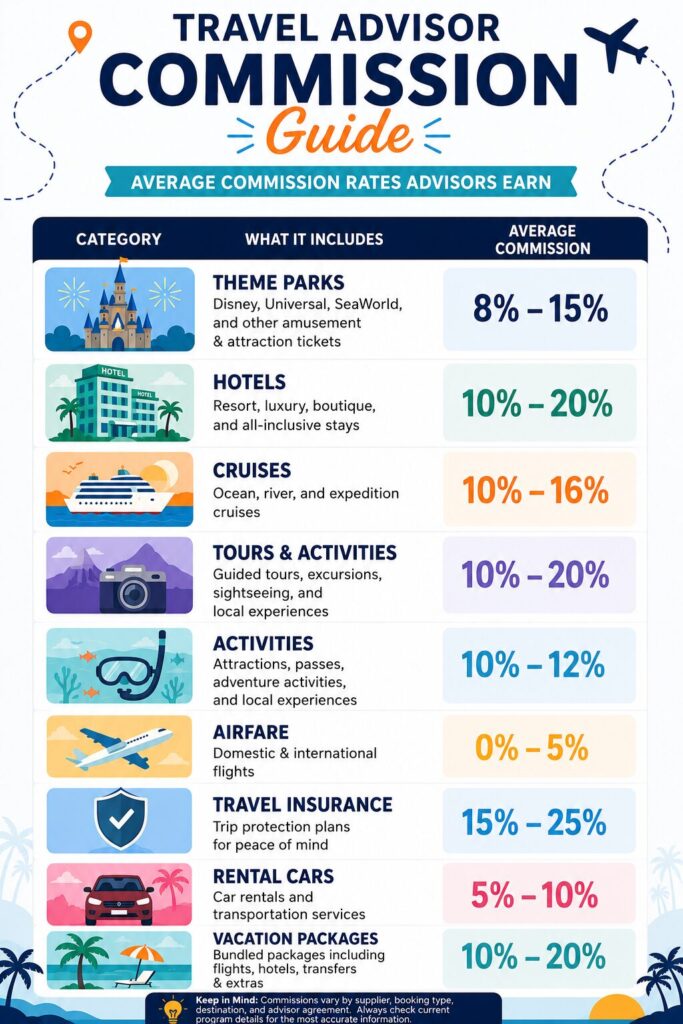
For a travel advisor, income is driven by commission and will grow in proportion to the size of the bookings one puts together, as well as the effort put in and the chosen niche. Those who are independent and operate through a host agency usually divide up the commissions; under most host agreements an agent can expect to take home 60 to 90 per cent of what the supplier pays.
Tampa has a robust market for cruises, hotels and events, so an agent with a specialty and a reliable stream of referrals can make it quite profitable in the first two years or so. This is particularly true when there is a core of repeat clientele on hand to book their annual cruise or a family holiday.
Travel Agent Sales Commission Calculator
This calculator takes the gross trip sales, applies the supplier commission rate, then shows the agent payout at a 70% commission split.*
Enter the booking total and commission rate.
See the payout update in real time.
Total sales booked
Gross commission
Final commission at 70%
*Estimated commissions are usually based on the travel price before taxes and extra fees. Actual payouts may also be lowered by normal credit card processing, technology, or transaction-related costs.
Travel prices can change because of availability, travel dates, supplier updates, or occasional pricing errors, so the numbers shown here are examples only and are not guaranteed income.
What Do Travel Agents Actually Earn In Tampa?
There’s some disparity in the salary data for Tampa travel agents, what with the different sources and the question of whether one is looking at an employed role or independent commission work. Indeed puts the average at between $17.36 and $23.30 per hour for a given reporting period. You’ll find similar figures from ZipRecruiter; their numbers point to an annual average in the vicinity of $39,000 to $40,575 (or about $18.79 an hour), with most people earning in the $15.91 to $20.67 range.
For the most part these are hourly, employed positions. The independent advisor operating on commission is a different matter altogether since there is no ceiling. Standard industry commissions are 5 to 10 percent of the trip value, but some host agencies will tell you they see 12 to 15 percent on cruise and package bookings. With the kind of volume Port Tampa Bay sees, a local advisor with a good following of cruise clients can put those hourly averages to shame in a couple of years.
Let’s be frank: one does not go into this business to get rich in the first year. That kind of income is built over time through referrals and repeat customers, not a regular paycheck. The successful ones know to spend year one cultivating relationships rather than trying to maximize what they take home.

What It Costs to Start
Starting costs will change whether you choose to work with a host agency or to be independent.
With a host agency, the initial outlay is minimal. The bill might come down to nothing more than host fees (training, insurance, supplier relations) registration, some basic branding and maybe an optional certification or two if you choose. You can easily become a travel agent in Tampa for around $100 depending on which agency you go with.
Take the independent path and those figures will rise quickly; there’s the expense of setting up the business, securing bonding and insurance, gaining access to suppliers and so on. In the end, most newcomers find the host option to be the less taxing choice, both for their nerves and their finances. You’ll easily be paying $25,000+ going this route.

Common Mistakes To Avoid
There’s a number of mistakes I see new advisors make when starting off, so here’s my list of things you should avoid to make your life a little easier:
-
Skipping training.
-
Choosing the wrong host.
-
Ignoring legal registration.
-
Trying to be too broad.
-
Underpricing your time.
-
Waiting too long to market yourself.
-
Giving up before referrals kick in.
The people who do best are usually the ones who stay consistent. They keep learning, keep talking to people, and keep showing up.

FAQ
Do I need a college degree to become a travel agent in Tampa?
No. Florida does not require a degree, exam, or special travel agent license to start selling travel.
Is Florida really one of the few states with special travel agent rules?
Yes. Florida is one of a small number of states with a Seller of Travel law requiring registration with FDACS for anyone selling travel for compensation.
How much does it cost to become a Seller of Travel in Florida?
The standard registration fee is $300 annually, plus a surety bond that typically costs around $100 to $250 per year depending on coverage amount.
Can I skip the Seller of Travel registration if I join a host agency?
Yes, in most cases. If your host agency already holds a valid Seller of Travel registration, you can register as an independent agent under their license for a $50 annual fee instead.
Do I need an IATA number to start booking travel?
You need access to one to book flights directly and earn airline commissions, but most new agents get this through their host agency rather than applying independently.
Is cruise travel really a good niche for a Tampa-based agent?
Yes. Port Tampa Bay is homeport to Royal Caribbean, Celebrity, Carnival, and Norwegian, giving local agents a genuine geographic advantage over agents elsewhere in the country.
How many people actually visit Tampa each year?
Hillsborough County welcomed over 28 million visitors in 2025, generating $9.5 billion in total economic impact.
What certifications should I consider as a new Tampa travel agent?
The Certified Travel Associate credential is a solid starting point, and a cruise-specific certification like CLACC pairs especially well with Tampa’s cruise market.
Is now a good time to specialize in Tampa travel given the international visitor slowdown?
Yes, potentially. International visitation to Tampa has softened recently, which often creates better pricing and availability, something a well-informed agent can use to their client’s advantage.
Can I run my travel agent business from home in Tampa?
Yes, most independent agents work entirely from home, though it is worth checking local zoning rules in your specific city or county before advertising a home-based office.

Final Thoughts
Becoming a travel advisor in Tampa, FL is one of the best decisions you’ll make this year! Probably the easiest one as well.
Tampa gives you a genuinely rare advantage: a booming tourism market, a major cruise port, and a steady flow of both local and visiting travelers who need guidance. Get your compliance sorted, pick a niche that plays to Tampa’s strengths, and start building relationships in your community. The travel industry rewards people who show up consistently and know their market cold, and few markets are hotter right now than Tampa Bay!