
Your host agency may have changed, but your career is still in your hands.
When a host agency closes its agent program, the first few days can be overwhelming. Your phone might ring nonstop, clients may have questions you can’t answer right away, and you’ll have quotes and upcoming trips to manage while figuring out which portals are still accessible.
Take a moment to breathe. The host agency provided structure, but your business is built on your client relationships, supplier knowledge, workflows, and years of experience. Those are still yours.
This guide will walk you through what to do in the first 48 hours, the first week, and the first 30 days. You’ll also find advice on protecting your commissions, managing current bookings, communicating with clients, and choosing a new host that values your experience!

Who This Guide Is For
This guide is meant for advisors who:
- Already have clients and a booking history
- Have established relationships with suppliers and are familiar with their portals
- Have your own methods for quoting, booking, and following up
- Are looking for a reliable new home, not a beginner course
If this sounds like you, the goal is straightforward: keep your clients happy, make sure you get paid for your work, and return to booking as soon as possible.

Start By Understanding How You Were Employed
Before you do anything else, make sure you know what your working arrangement was with your previous company. This will determine what you are allowed to take with you.
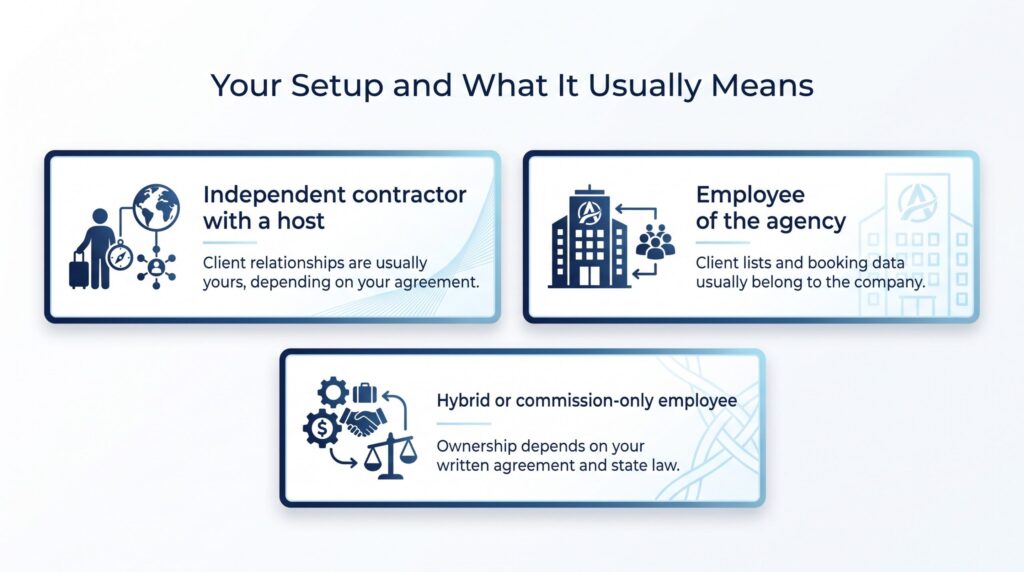
Why this matters: If you’re an employee, downloading company client lists could get you into legal trouble. Your experience, skills, and personal network still belong to you. If clients choose to follow you on their own, that’s fine. Just don’t take company data you’re not allowed to keep. If you’re unsure, talk to an employment attorney before exporting anything.
Real-life example: Two advisors left the same company on the same day. One was an independent contractor, and her contract said her clients belonged to her, so she exported her list and emailed every client that week. The other was an employee, so she didn’t touch the company database. Instead, she updated her LinkedIn and Facebook, and over the next month, many of her regular clients found her anyway. Both kept their businesses, but only one had to be careful about how she did it.

The First 48 Hours: Protect What You Have
The first two days matter most. Companies can turn off portals and email accounts without warning.
Save Your Records (if you can)
- Export your client list with names, emails, phone numbers, birthdays, anniversaries, and trip preferences
- Download every active and future booking with supplier, booking number, travel dates, deposit or payment status, and expected commission
- Save confirmations, invoices, payment schedules, and itineraries as PDFs
- Screenshot portal dashboards, commission reports, and pending payment pages
- Forward important client emails to a personal business email you control
Get Control of Your Contact Channels
- If clients only have your company email or phone extension, set up your own business email and phone number right away.
- Write down every place clients reach you: email, text, Facebook, Instagram, website forms
- If you have a company-branded social account, find out who owns it before you change anything
Calm Yourself Before You Call Clients
It’s tempting to call everyone immediately. Wait until you know what you’re allowed to say. A calm call in two days beats a nervous call today with no answers.
Quick tip: Make a “red list” of clients traveling in the next 30 days. They come first. Everyone else can wait a few days.

Reread Your Agreement Carefully
Your contract determines what you get to keep. Go through it slowly and highlight these key sections:
- Client ownership: Does the contract clearly state that your clients are yours?
- Commissions after leaving: Some contracts say that commissions for trips that happen after you leave go to the host. Watch for words like “forfeit,” “termination,” or “post-departure.”
- Payout timeline: When and how will you get your final commissions?
- Notice period: Most hosts usually require 30 to 90 days’ notice, but if the program is closing, this might be different.
- Non-compete or non-solicitation: Are there any rules that limit where you can work next or if you can reach out to your clients?
- Marketing materials: Who actually owns your website, social media accounts, and email list?
- Fees or balances owed: Do you still owe any money, or does the company owe you?
If the closure notice and your contract don’t match, ask the company to confirm their answer in writing. Even a short email saying “your commissions on bookings made before [date] will be paid by [date]” can be very helpful later.
When to get help: If you have a lot of commissions at risk or the contract is confusing, it’s usually worth paying for a one-hour call with an attorney who understands independent contractor agreements.

Build a Commission Tracker
Old commissions usually don’t appear automatically. You’ll need to follow up to get them.
What to Track for Every Booking
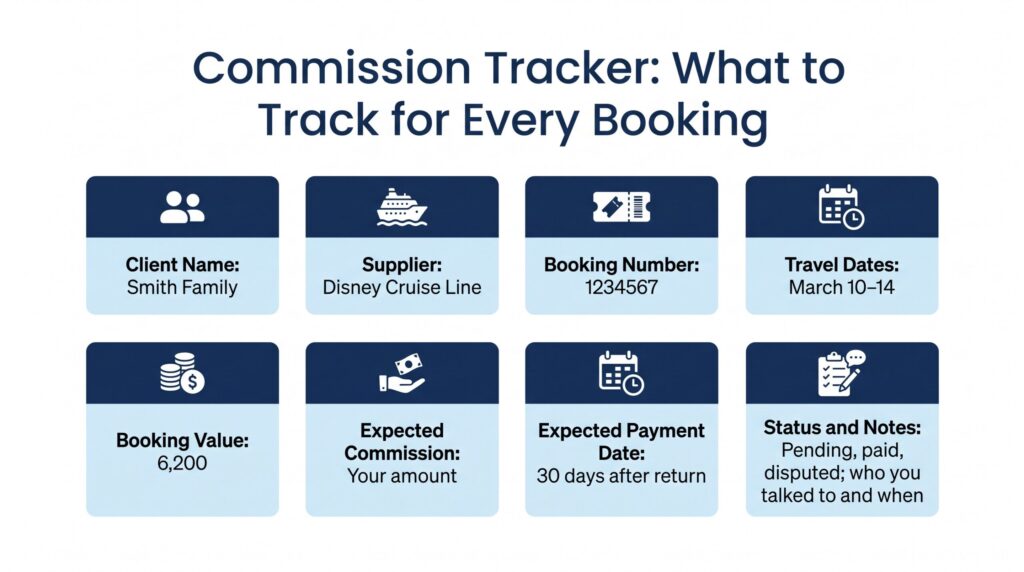
Tips for Getting Paid
- Organize your list by expected payment date so you don’t miss anything.
- Set a calendar reminder for one week after each payment’s due date.
- Keep track of every email and call about commissions, including the dates and names involved.
- If a payment is late, ask politely once, then follow up in writing.
- If a large amount remains unpaid after several attempts, seek legal advice.
Real-life example: An advisor has 14 pending bookings worth about 4,000 in commission. She tracks them in a spreadsheet and follows up every two weeks. Three months later, 12 have paid, and she has written records for the other two. Without the tracker, she would have guessed and probably lost a few.

Sort Every Booking Into a Group
Not every booking follows the same process. Sorting them early can save you a lot of stress.
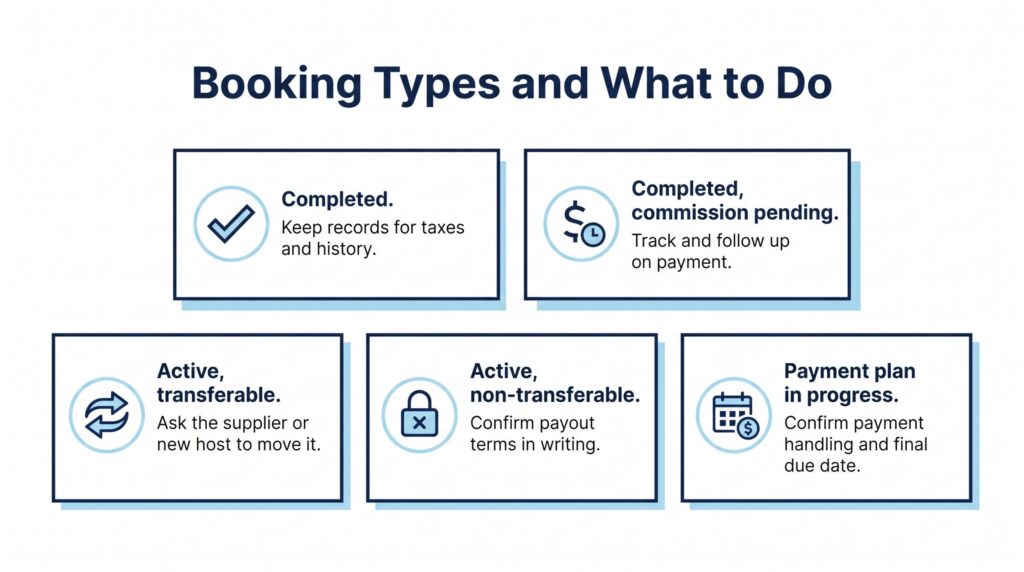
Booking Types and What Usually Happens
- Cruises: Most cruise lines let you transfer a booking to a new agency before the final payment is made. Just call the cruise line’s agency support team or your representative for help.
- Tour operators and vacation packages: You can usually transfer these, but each company handles it differently.
- Theme park packages: The rules depend on where and how you booked. Check with the supplier to be sure.
- Air tickets: Once tickets are issued, you usually can’t transfer them to another agency.
- Hotels booked direct: These usually stay as booked. The commission is tied to the agency number used at booking.
- Travel insurance: The policy remains active. Whether you get commission depends on the insurance company’s rules.
Focus on your most valuable bookings first. Moving one $15,000 cruise is a better use of your time this week than handling ten small hotel bookings.
A word about clients on payment plans
Clients who are paying for a trip over time need extra attention. They are often the most concerned. Make sure each one knows:
- Their trip is still booked
- Where their next payment goes
- When the final payment is due
- Who to call with questions
Giving clear answers helps keep anxious clients from canceling.

Talk to Your Supplier Reps Early
Supplier reps, also known as BDMs, can be a great resource when you are moving to a new agency. They want to keep your business and have probably helped other advisors through similar transitions.
What to Ask Each Rep
- Can my active bookings move to a new agency, and how?
- Will my training, certifications, or specialist status carry over?
- What do you need from my new host to update my profile?
- Is there anything I should do before my old access shuts off?
What to Expect
- Some suppliers will transfer your training, while others may require you to complete it again.
- Some suppliers will need your new host’s IATA, CLIA, or other agency number before they can update your profile.
- Some updates happen in a day, while others may take a few weeks.
List your top five suppliers based on booking volume and contact those reps first. These relationships will have the biggest impact on your income in the coming year.

Choose a Host That Fits an Experienced Advisor
This is an important decision, but it doesn’t have to take long. You are not starting over; you are simply finding a new place for the career you have built.
What Experienced Advisors Actually Need
- Speed: Credentials and supplier access within days, not weeks
- Access: The suppliers you already book, without hoops
- Freedom: No forced beginner training, no micromanaging
- Fair pay: A clear commission split with no surprise fees
- Tools: A CRM and back office to keep your clients organized
- Support: Real people who answer when a client problem comes up
Questions to Ask Every Host
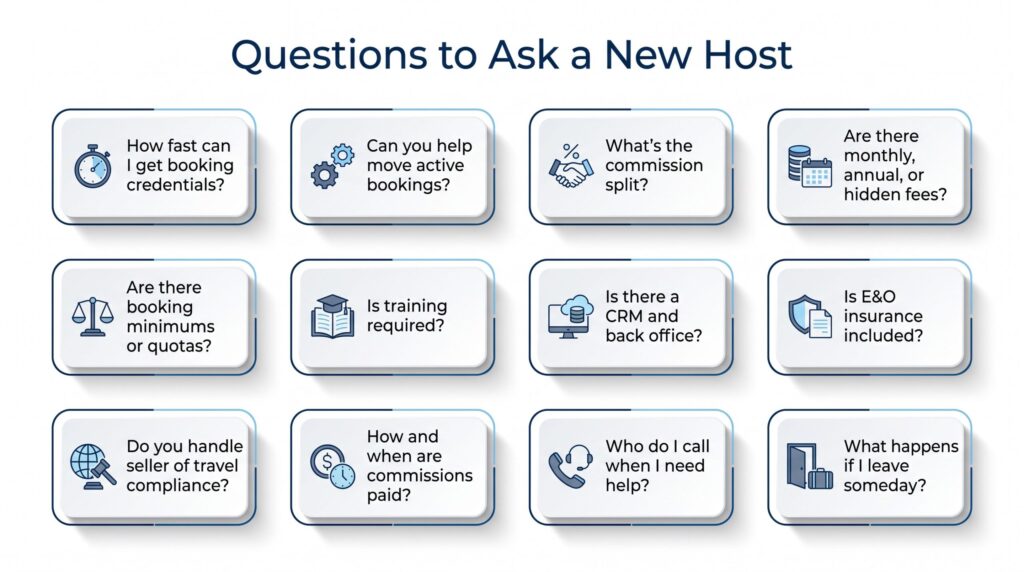
Contract Red Flags
- Make sure to watch for these things before you sign any contract:
- Clauses that claim the host owns your clients
- Losing your commission if you leave, even for trips you already booked
- Non-compete periods that last a long time
- Unclear fee terms, such as “fees may change at any time”
- Requirements to buy training, websites, or marketing packages
- No clear schedule for when you get paid
Here’s an example: One advisor compared two hosts. Host A gave her an 80% split but charged a monthly fee, an annual tech fee, and a fee for every booking. Host B offered a 70% split, but enrollment was free, and there were no booking minimums. With her sales volume, Host B actually paid her more each year. The split is just one part of the equation.

Tell Your Clients the Right Way
Your clients trust you, not the logo on your emails. How you tell them about the change matters as much as the change itself.
When to Reach Out
Hold off on reaching out until you’ve signed with your new host. This way, you can give your clients real answers instead of saying, “I’ll let you know.”
Who to Contact First
1. Clients traveling in the next 30 days
2. Clients on payment plans
3. Clients with bookings later this year
4. Past clients and repeat travelers
5. Everyone else on your list
How to Reach Out
- Personally call your most important clients
- Send a brief email to everyone else
- Share a calm update on your social media
Client Email Template
Subject: A quick update about your trip
Hi [Name],
I wanted to let you know that my business has joined a new host agency, Yeti Travel. Nothing will change for you. I’m still your advisor, your trip is on track, and you can reach me just like before.
[If they have an active booking:] Your [trip] on [dates] is still confirmed, and I’m making sure everything goes smoothly. [Add any payment or document changes here.]If you have any questions, feel free to reply or call me at [number]. I’m always happy to help.
Thanks for trusting me with your travel,
[Your name]
Text Message Template
Hi [Name], I wanted to let you know that my business has joined a new host agency, Yeti Travel. Your trip is still set, and I’ll continue to be your advisor. Feel free to call or text me if you have any questions.
Social Media Post Template
You may have heard that there have been some changes at my previous host agency. I want to reassure you that my business is still going strong, and I’m still here to help. I’ve now joined Yeti Travel and am booking trips as usual. If you have a trip planned or are thinking about one, feel free to get in touch anytime.
What Not to Say
- Avoid speaking negatively about your previous company, even if you feel frustrated.
- Don’t guess about things you haven’t confirmed
- Keep your communication simple and avoid giving clients unnecessary industry details.
Clients mostly want to know two things: their trip is secure, and you are still taking care of everything.

Your Transition Timeline
Days 1 to 2
- Keep copies of any records and booking details you are permitted to retain
- Create your own business email and phone number if you need them
- Make a priority list of clients who are traveling soon
- Read your agreement again to make sure you understand it
Days 3 to 7
- Set up a tracker to monitor your commissions
- Organize all your bookings into groups
- Reach out to two or three possible host agencies
- Call your main supplier representatives
Week 2
- Sign with your new host
- Submit your paperwork and request credentials
- Get in touch with clients who are traveling soon and those on payment plans
- Begin transferring any bookings that can be moved
Weeks 3 to 4
- Send an email to your entire client list
- Update your website, email signature, social media profiles, and business cards
- Make your first booking with your new host agency to confirm everything is working
- Continue to follow up on any commissions that are still pending
Days 30 to 90
- Complete transferring all remaining bookings
- Repeat any supplier training that did not carry over
- Check your commission tracker each week
- Go back to your regular marketing routine

Update Your Brand and Marketing
After you’ve settled in, check that all your information leads people to your new location.
Your Update Checklist
- Website and booking forms
- Email signature
- Facebook, Instagram, LinkedIn and other profiles
- Google Business Profile, if you have one
- Business cards and printed materials
- Email newsletter footer
- Any directories or listings where you appear
- Supplier profiles and specialist directories
Turn the Change Into a Fresh Start
Moving gives you a good reason to reach out to past clients. Sending a quick message about your new location can often bring back people who haven’t booked with you recently.
Add a simple line to your email signature for the next few months: “My business has moved to Yeti Travel. Same advisor, same service.”
Take Care of Yourself, Too
Losing your host can be stressful, even if you’re managing it well. Here are a few things to keep in mind:
- You don’t have to make every decision today
- Lean on other advisors going through the same thing
- Make a note of what’s working and what isn’t. This way, if you ever move again, the process will be easier.
- Remember, your clients chose you for a reason, and most will continue to do so.

Common Mistakes to Avoid
- Don’t wait to save your records. Sometimes, portal access can be removed without notice.
- Only take data that belongs to you. Taking information you don’t own can lead to legal issues, especially if you’re a former employee.
- Hold off on telling clients until you have clear answers.
- Don’t rush into picking a host. Moving quickly is fine, but always read the contract first.
- Look at more than just commission splits. Fees and support are just as important.
- Forgetting about pending commissions. Track every one.
- Avoid speaking negatively about your previous company. It reflects more on you than on them.
- Don’t skip calls with suppliers. Their reps might help you solve issues you weren’t aware of.

A Soft Landing at Yeti Travel
You don’t need to rebuild. You need somewhere to keep building.
Yeti Travel is designed for advisors who already know the business. We won’t make you start from scratch or go through unnecessary training. We’ll help you get set up, give you the tools you need, and let you work your way.
What Moving to Yeti Looks Like
1. Enroll for free. No startup fee, no waiting period.
2. Receive your credentials and start booking with suppliers within 48 hours.
3. Continue right where you left off. You keep your clients, your workflow, and your way of working.
What’s Included
- 70% commission split
- Free enrollment
- Free CRM to keep your clients organized
- No booking minimums or quotas
- You’ll get real people to help you whenever you need it.
- E&O coverage
- Help with moving active bookings
- Support
What We Won’t Do
- Make you redo beginner training
- Pressure you with quotas
- Tell you how to run your business
We won’t pressure you or give you a sales pitch. If you want to talk about your situation, we’ll focus on what matters to you.

Checklist for Your Transition
Protect Your Interests
- Check if you were classified as a contractor or an employee
- Keep copies of any records you are permitted to save
- Set up a personal email address and phone number
- Read through your agreement again
Track Your Progress
- Create a tracker for your commissions
- Organize all your bookings into groups
- Make a priority list of clients who are traveling soon
Make the Move
- Select your new host agency
- Ask for your new credentials
- Reach out to your main supplier representatives
- Transfer any bookings that can be moved
Reconnect with Your Network
- Contact your clients, starting with the most urgent
- Update your website, email signature, and online profiles
- Make your first new booking
Follow Up Regularly
- Check your commission tracker each week
- Repeat any training that was not carried over
- Resume your usual marketing activities

Frequently Asked Questions
Do I lose my clients if my host agency closes?
In most cases, you keep your clients if you were an independent contractor and your agreement says so. If you were an employee, the company might own the client data. No matter what, your relationships and reputation stay with you.
Will I still get paid for bookings made under my old host?
Most agreements pay commissions on bookings made before you leave. Some contracts say you lose commissions for trips that depart after you leave. Check your agreement, get payout terms in writing, and keep track of all pending payments.
Can I transfer active bookings to a new host?
You can often transfer trips that haven’t departed yet, if the supplier allows it. Cruise lines and tour operators usually let you transfer bookings. You usually can’t move air tickets that have already been issued or some direct hotel bookings.
What happens to clients on payment plans?
Their trips usually remain booked. Be sure each client knows where to send their next payment, when the final payment is due, and who to contact with questions.
Will my supplier training transfer?
Sometimes your training will transfer, but it depends on the supplier. Ask each representative, and be prepared to redo some training if needed.
Can I keep my CLIA card or other credentials?
Some credentials can transfer to your new host, sometimes for a small fee. Others may need to be reissued. Check with your new host and the organization that issued your credentials.
How long does switching hosts take?
Updating your credentials can take anywhere from a few days to a few weeks, depending on the host and supplier. Moving bookings and updating your profiles might take a month or longer.
Should I tell clients before I choose a new host?
It’s usually best to wait until you’ve signed with a new host before telling your clients, so you can answer their questions clearly. If someone is traveling soon, give them a quick, reassuring call ahead of time.
Do I need my own E&O insurance?
It depends on the host. Some include it, some require you to buy it, and some don’t offer it. Ask before you sign.
How fast can I start booking with Yeti?
At Yeti, you can start usually start booking within 48 hours.
Do I have to go through training at Yeti?
No, you don’t have to. Training and tools are available if you want them, but experienced advisors don’t need to start over.

Your Host Agency Closed, but Your Business Keeps Going
When a host agency closes, it can feel disruptive, but it doesn’t have to be the end. Imagine two advisors in the same situation. One spends weeks unsure of what to do, while the other quickly saves her records, contacts her top suppliers, joins a new host, and secures her first booking within a month. The key difference isn’t experience; it’s a clear plan and a supportive host who makes the transition smoother.
You’ve already accomplished the hardest work. You’ve earned your clients’ trust, learned about your suppliers, and built a business people depend on. Now it’s time to find a new place where your business can keep growing. We’d love to have you here at Yeti Travel! Contact us about our Agent Transfer membership, which is free, to keep your business running smoothly.