Jacksonville pulled in 8 million visitors and $4.1 billion in direct spending last year, and it has its own cruise port sending Carnival ships to the Bahamas year-round. If you have ever thought about turning your love of travel into a business, Jacksonville gives you more to work with than most people realize.
Getting started as a travel agent here does not require a special degree or exam, just the right paperwork and a plan! Here’s the full breakdown.

Why Jacksonville Is a Solid Base for a Travel Agent
Jacksonville was responsible for 8.2 million visitors in 2024. These put nearly 5 million room nights on the books and left $4.1 billion in the local economy to the tune of some 60,000 jobs supported. For a city that’s all too easy to dismiss in the shadow of Orlando or Miami, it’s a considerable amount of foot traffic, which means more clients!
There’s an interesting dynamic at play, over half of those who come to town are here to see friends and relatives, with 45 percent putting up in hotels. An agent would do well to note that this means locals are not only making plans to get out of Jacksonville but are also fielding travelers who require assistance with day trips and hotel arrangements while they’re in the area.
The numbers for the state as a whole tell the same story. Florida set another record in 2025 with 143.3 million visitors, and Jacksonville International Airport is on an upward trajectory to match it. With a functioning cruise port in the city as well, there’s ample reason for a resident to put their trust in a nearby professional rather than a call center halfway across the country.
How to Take Advantage of This
Most of the competition fails to see what a goldmine the, “visiting friends and relatives” can be. Tons of Jacksonville residents have family coming in for tons of different travel reasons. Rather than letting them make a one-off flight search, you can position yourself as the local authority to handle the hotel, the airport run and even a side trip to St. Augustine or the beach, thereby securing a multi-service booking from a single visit!
It’s these kinds of small things specific to your area that can make you stand out from the rest of the pack! Don’t underestimate the power of a niche in your area.

Florida Travel Agent License
Luckily there’s no need for a special travel agent license, degree or exam in Florida! It does however have Seller of Travel laws that are enforced across the board, Jacksonville included.
If you’re in Florida and being compensated for the sale or marketing of travel services, you have to register with the FDACS (the Florida Department of Agriculture and Consumer Services). The rule is not limited to where you happen to be located; it also hinges on the residence of your client. So even if most of your business is outside of Jacksonville, it’s something to take seriously.
You have two options for compliance:
- The first is to go through a host agency as an independent agent. For an annual fee of $50 you can register under them and make use of their existing Seller of Travel registration. It’s by far the quickest and most economical way to get up and running.
- Or, for those who want to operate a fully independent agency, you can obtain your own Seller of Travel license from FDACS. That involves a nonrefundable $300 filing fee and putting in place a surety bond with coverage in the $10,000 to $25,000 range.
If you go the business route, here’s what you can expect:
- Put together a business entity with the Florida Division of Corporations, an LLC for instance. Get an EIN from the IRS at no charge. You will need to buy a surety bond, which runs about 10 percent of its face value a year. Then file your proof of bond along with the $300 and your registration form with FDACS.
- Once approved, make sure to display your Seller of Travel number on your site and in any marketing you do! Do not book any paid trips until you have that nod from FDACS; the process may run as long as 30 days.

Training and Certifications Worth Pursuing
While the law in Florida doesn’t make you get any kind of certification, they are valuable for instilling the kind of practical skills you put to use every day and for earning a client’s confidence.
It’s the same concept of a Doctor putting their degrees on the wall in the waiting room. Mentally it gives everyone reassurance that this person knows what they’re doing.
These days the most practical certifications are:
- There’s the Certified Travel Associate (CTA), an entry-level credential that is well suited for learning the ins and outs of destination knowledge and sales.
- For an agent with some years under his or her belt, the Certified Travel Counselor (CTC) represents a natural progression.
- In a place like Jacksonville with its local cruise port, the Cruise Lines Association’s CLACC designation is of particular value.
- Then there’s the onboarding from a host agency; most will put you through their own training at no cost to cover supplier relations and how to work the booking systems.
How Travel Agents Earn Money
The way travel agents make their money can be broken down into two main methods, though most just use the first one.
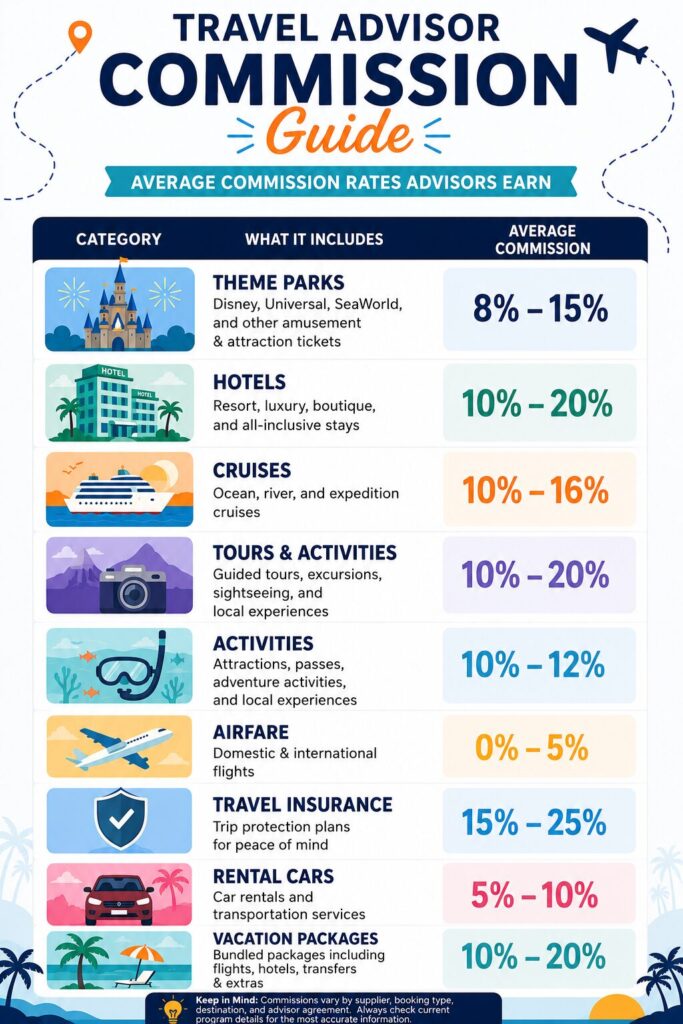
Commissions from Suppliers: Travel agents work with suppliers (Disney, Universal, Carvinal Cruise etc.), those suppliers pay agents a percentage of the cost of the clients booking. The percentages can change depending on what the trip is (cruise, theme park, hotel, etc.). So clients don’t have to pay any extra for a travel agent’s help, which makes it easier to find clients.
Service Fees: Sometimes agents charge a service fee to book trips, however most don’t unless the booking is massive or difficult. The reason most choose not to is that there’s plenty of other agents out there that won’t charge a fee for the same booking. So carefully decide when if at all to charge a service fee.
If you work under a host agency, which most new agents do, expect a commission split rather than keeping 100%. Standard splits start around 70/30 in the agent’s favor.
Travel Agent Sales Commission Calculator
This calculator takes the gross trip sales, applies the supplier commission rate, then shows the agent payout at a 70% commission split.*
Enter the booking total and commission rate.
See the payout update in real time.
Total sales booked
Gross commission
Final commission at 70%
*Estimated commissions are usually based on the travel price before taxes and extra fees. Actual payouts may also be lowered by normal credit card processing, technology, or transaction-related costs.
Travel prices can change because of availability, travel dates, supplier updates, or occasional pricing errors, so the numbers shown here are examples only and are not guaranteed income.
Average Travel Agent Earnings in Jacksonville
Indeed and ZipRecruiter have job listings that show hourly wages for W-2 staff in the $19 to $24 range; for an entry-level position this comes to about $32,000-$40,000 annually. Glassdoor offers a more expansive view with an average near $59,000, and certain salary trackers put the figure at over $100,000. The difference is easy to explain when you consider they are all being categorized together, from part-timers and specialists making top dollar to those whose income is largely commission as an independent.
For the independent agent, you can get a better sense of things from the industry data. The numbers show that a full-time advisor in their first five years will put in about $44,000 on average. Move up to a mid-level position with an established book of business and earnings are in the $66,000 to $79,000 range. Then there are the top performers in luxury, corporate or group travel who routinely make $100,000 and up!
It’s not just the hours put in that makes the difference but the value of what’s being booked and the agent’s particular niche as well. Take a 15% commission for example on a $5,000 luxury package, it’s a good deal more than the same percentage off a $500 hotel room. The more time you put into your work the more you’ll make!
Best Ways to Increase Income as a Jacksonville Travel Agent
- The way to own a niche is to choose one with real value. By making a specialty of luxury travel, cruises or destination weddings, you put yourself in the position of the local authority and can set your prices without the need to compete.
- There’s little point in selling off single bookings when you can put together full packages. While a hotel on its own will bring in a 10% commission, bundling in insurance, excursions and transfers for a complete package can see your margin come in at 15 – 25%.
- Make group and corporate travel a priority! The planning for an incentive trip or a wedding may be no more involved than for an individual, but the payout covers many travelers at once. And don’t leave money on the table with add-ons; it’s simple to include airport transfers or an excursion with any Jacksonville beach or cruise package for a 10 – 35% commission.
- Over time, work to establish direct ties with vendors rather than relying on what a host agency has to offer. Preferred and eventually direct supplier relationships are how you get to those upper commission tiers.
In the end, aim to make every client a regular. A repeat booking is the best revenue you can have because you are not spending anything to acquire someone you already know.
Picking a Niche That Fits Jacksonville
So why choose a niche? It’s the best way to stand out from other general travel agents! It’s also been proven that agents who specialize tend to earn more money! It usually requires you to learn more about certain ways of travel, but it’s definitely worth it, especially in a city like Jacksonville.
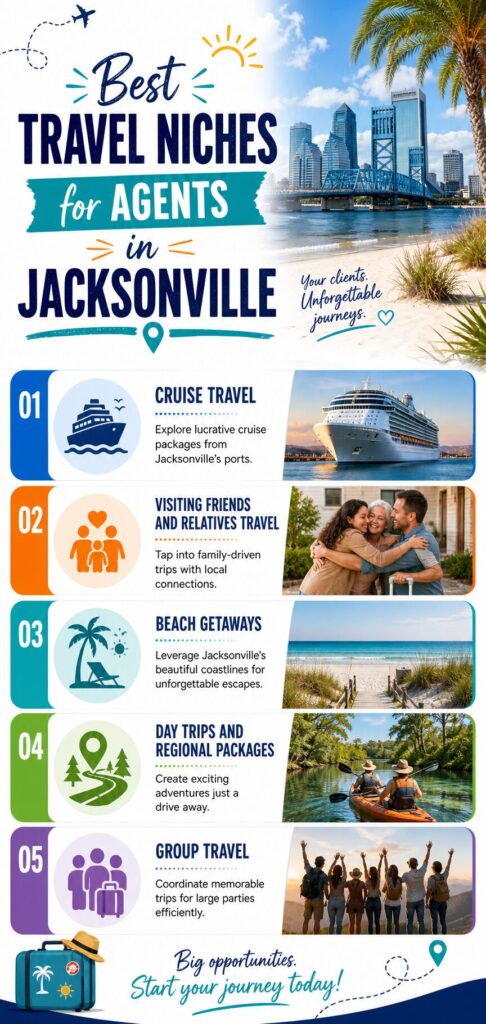
A look at the tourism figures in Jacksonville reveals a handful of niches where a local agent can put down roots.
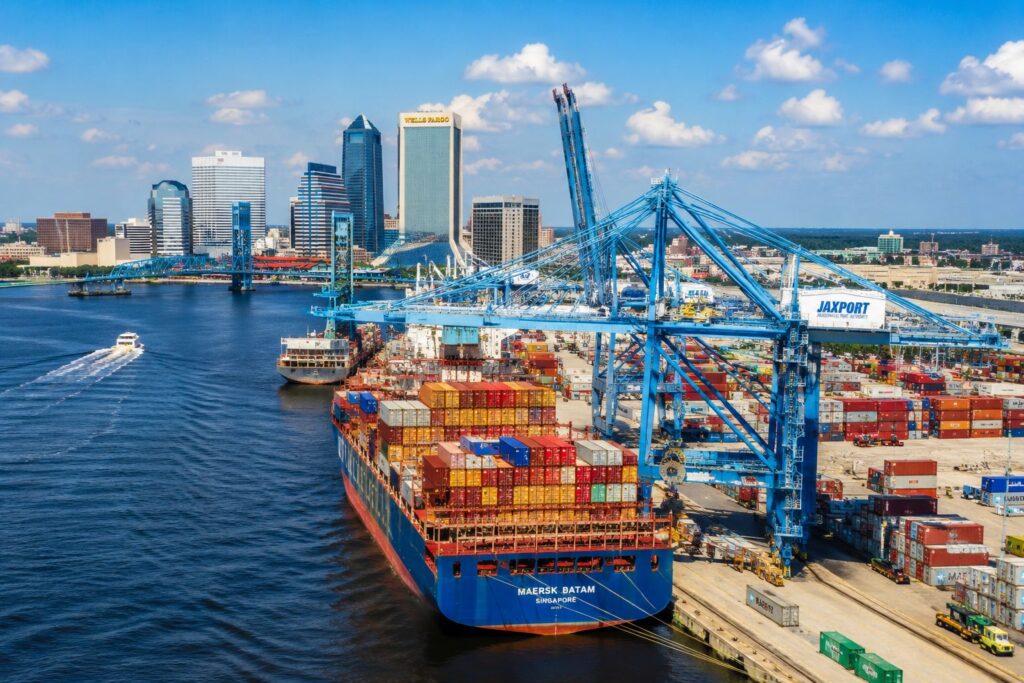
There’s cruise travel, for instance. JAXPORT has Carnival ships putting out on four and five-day runs to the Bahamas all year, and Norwegian Cruise Line has added seasonal sailings from November to April.
Then there’s the matter of friends and relatives. With over half of all visitors in town for that purpose, an agent who can handle hotel bookings or put together day trips for hosted guests is answering a demand.
The same goes for beach and coastal excursions; with Amelia Island and Jacksonville Beach on the doorstep, it’s a regional specialty not hard to develop. Agents can also put together some straightforward day trip or regional packages by bundling in a tour of the Anheuser-Busch Brewery, the Jacksonville Zoo or a run to St. Augustine as a nice add-on to a weekend or pre-cruise booking.
Making Use of This As a Travel Advisor
For much of the year JAXPORT is a port of one line only, so it doesn’t have the trappings of a larger facility such as on-site rental cars or airport transfers from the cruise line. But that’s where an agent can be of service! For the first-time cruiser in Jacksonville, someone who can tell you which hotels have a free shuttle to the port, how to make the 30-minute check-in window work and which taxi or rideshare will actually be on time is worth their weight in gold!
Write articles, post on social media, do all the big marketing for something like this and it’ll make you stand out from the others.
FAM Trips and Why They Matter
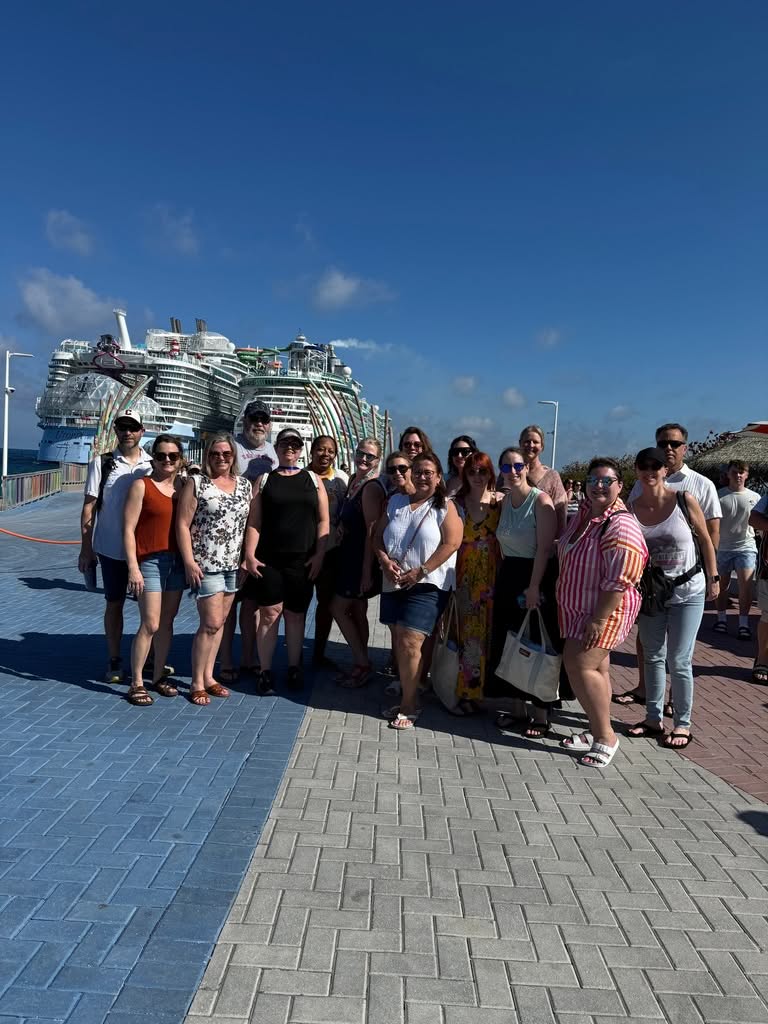
FAM trips, short for familiarization trips, are discounted or complimentary trips offered by hotels, cruise lines, and tourism boards so agents can experience a destination firsthand before selling it to clients. These trips are one of the most valuable perks of the job, giving you real, personal knowledge of a resort, ship, or destination instead of just relying on brochures or other people’s reviews. Some host agencies require you to prove some booking volume with a supplier before qualifying for FAM trip invitations, others let you go no matter how much you’ve sold. Another reason choosing the right agency is really important!

Common Mistakes New Agents Should Avoid
Forgetting to register as a Seller of Travel: Florida makes this non-negotiable, so do not be caught without it. Even if there is no mandate for an agent license in full, the absence of this registration can put an end to your business before you are off the ground.
Host Agency Commission Split: It’s all too common for new agents to sign on and only later discover they were not clear on their take-home percentage, which is a source of needless frustration.
Attempting to be all things to all travelers: You’ll find that marketing becomes an uphill battle and clients get confused if you try to cover cruises, luxury excursions and budget backpacking in equal measure at the same time.
Not putting a proper value on your time with complicated bookings: A group trip or a multi-stop itinerary can consume hours of planning, yet many newcomers have a habit of undercharging for such work.
Overlooking supplier certifications: There is no point in turning down free training from suppliers. Doing so leaves you out of the running for better commission tiers and eligibility for.

Frequently Asked Questions
Do I need a special license to become a travel agent in Jacksonville?
No specific travel agent license is required in Florida, but you do need Seller of Travel registration if you sell travel for compensation.
Can I sail on a cruise directly from Jacksonville?
Yes. JAXPORT homeports Carnival ships year-round on Bahamas sailings, with Norwegian Cruise Line offering seasonal sailings from November through April.
How much does Seller of Travel registration cost in Florida?
Standalone registration costs a $300 nonrefundable fee plus a surety bond, while joining a host agency’s registration costs just $50 annually.
Do I need an IATA number right away?
Not necessarily. Most new agents access IATA benefits through their host agency instead of applying independently.
What are FAM trips and can I go on one as a new agent?
FAM trips are discounted or free trips offered to agents to experience destinations firsthand, but most suppliers require some booking history before extending an invitation.
How many people visit Jacksonville each year?
About 8.2 million visitors came to Jacksonville in fiscal year 2024, generating $4.1 billion in direct spending.
Is Jacksonville’s cruise port as big as Miami’s or Tampa’s?
No, JAXPORT is a smaller port, primarily served by Carnival, though it still moves over a million cruise passengers annually and offers free, secure parking on-site.
What’s a common mistake new agents make in Florida specifically?
Skipping Seller of Travel registration is one of the biggest, since it is a legal requirement even though no formal agent license exists.
Can I run my travel agent business from home in Jacksonville?
Yes, most independent agents work from home, though it is worth checking local business tax receipt rules for your specific municipality.
What kind of trips should I specialize in as a Jacksonville-based agent?
Cruises through JAXPORT and travel support for the large “visiting friends and relatives” traveler segment are two strong niches backed by local data.

Time to Get Started
Jacksonville has real tourism numbers behind it, a working cruise port, and a unique visitor base built around people coming to see family. Handle your Seller of Travel registration, pick a niche that plays to the city’s strengths, and start building relationships in your own community. The agents who succeed here are the ones who know Jacksonville better than any national call center ever could. Get out there and start earning today!