
Group travel for new agents begins with an exciting idea: one vacation can bring together families, friends, or even a whole community!
Imagine cousins sharing breakfast before heading to a theme park. Think of a book club watching the coastline from a cruise ship. Or grandparents finally bringing everyone together for a long-awaited beach trip.
You can help create these special moments!
Behind every happy group photo, there is also the less exciting part of the job: handling deposits, room assignments, cancellation policies, and last-minute requests from guests.
This is where a good travel agent truly makes a difference.
For your first group, focus on keeping things simple and manageable. You don’t need a complicated itinerary. What matters most are the right travelers, clear expectations, reliable suppliers, and a way to keep track of important details.
This guide will help you through each step, from your first talk with a group leader to the follow-up that might lead to your next booking!

Group Travel for New Agents: The Quick Answer
Group travel planning is about organizing trips for people who share a connection, such as friends, colleagues, or members of an organization. As a group travel agent, you help find the right travel options, explain booking details, handle reservations, and keep the group updated.
Here’s how to begin:
1. Look for a group that has a clear purpose for traveling.
2. Check the group’s budget, preferred travel dates, and a realistic number of travelers.
3. Pick travel suppliers that match the group’s needs.
4. Go over contracts and make sure everyone understands their financial responsibilities.
5. Explain how pricing works, what deposits are needed, and the rules for cancellations.
6. Gather reservations using the approved booking systems.
7. Keep track of important deadlines and help travelers get ready for their trip.
There isn’t one standard group size in the travel industry. For example, American Airlines offers group options for 10 or more people, while Princess’s Celebration Group Program has its own rules for staterooms. Be sure to check the requirements for each supplier and program.

1. Understand Why Group Travel Can Be a Smart Specialty
A single well-chosen group can help you connect with several households at the same time.
Rather than beginning each booking from the ground up, you focus on a shared event like a reunion, milestone birthday, club outing, or retreat.
That creates opportunities for:
- Multiple reservations connected to one trip.
- Relationships with community organizers.
- Repeat annual departures.
- Referrals from travelers who experience your service.
- A recognizable specialty within your travel business.
However, having more travelers does not always lead to higher earnings.
Group trips require extra work, such as reviewing contracts, tracking payments, managing room lists, and coordinating details. Your supplier commissions might also go through your host agency and be split based on your agreement.
A better question to ask is not just:
“How much travel can I sell?”
It’s:
“What will I earn for the work and responsibility involved?”
This is the kind of business mindset you should develop early on.

2. Choose the Right Type of Group
Before picking a destination, think about what type of group you want to organize.
Affinity Groups: People Who Already Share a Connection
An affinity group is made up of people who already have a connection, like a family, hobby club, alumni association, or community group.
These groups usually have a leader who acts as your main contact. This connection gives the trip a clear purpose before you even start promoting it.
Examples include:
- A multigenerational family reunion.
- A photography club’s coastal getaway.
- A retirement celebration.
- A friends’ cruise.
- A local organization’s annual vacation.
For your first group trip, it’s better to work with an existing group that has a reliable organizer, rather than trying to fill a trip from the ground up.
Speculative Groups: You Create the Trip and Find the Travelers
With a speculative or promotional group, you book travel space first and then market it to possible travelers. These travelers might not know each other, and you may need to handle tasks that a group leader would usually manage.
A food-focused cruise or hosted theme-park getaway could fit this model.
The main challenge is finding enough interest. Even if the itinerary looks great, it does not guarantee enough people will sign up.
Before you commit, find out the supplier’s rules for group bookings and check if your audience is interested in that specific trip.
Escorted Versus Unescorted Trips
You should also decide if you will just organize and coordinate the trip, or if you will travel with the group as well.
If you intend to host, spell out your role:
- Are you organizing daily meetups?
- Are you handling arrival assistance?
- Are you available during set hours?
- What support will travelers receive while you’re on-site?
If you are hosting the trip, make sure your pricing covers your travel costs, work while on-site, and time away from your other business.

3. Start With a Group You Can Realistically Serve
Your first group booking should be one where you understand all the details and steps involved.
Look for:
- One main destination.
- A clear purpose.
- A realistic budget.
- A reliable decision-maker.
- Limited itinerary changes.
- Suppliers your agency knows how to book.
For example, a family cruise that leaves from one port is usually easier to organize than a custom trip through five countries with travelers coming from different continents.
This does not mean every cruise is simple. Instead, judge how complex a trip is by the number of decisions, contracts, and details involved, not just by how many people are going.
Try the “Three Green Lights” Test
Before investing hours in proposals, look for three signs:
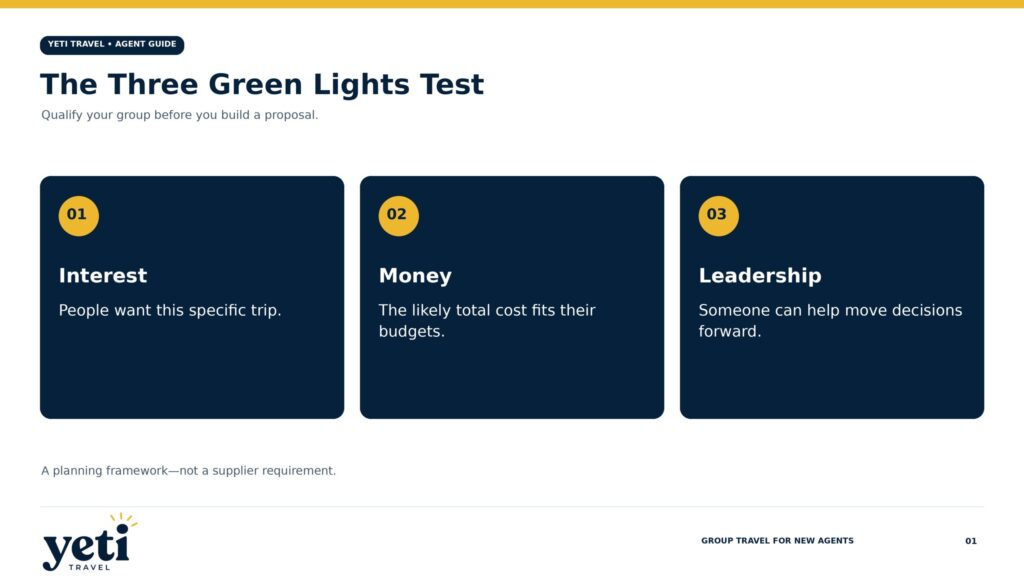
Your first task is to make sure the group is qualified, not to give them a quote.

4. Ask Better Questions Before You Build a Quote
Having a good intake conversation helps you avoid planning a trip that won’t get approved.
Ask the organizer:
- What’s the reason for the trip?
- Who makes the final decisions?
- How many people are interested, and how many are ready to book?
- Which dates are fixed?
- Where will travelers depart from?
- What can each person reasonably spend?
- Does that budget include flights?
- What room-sharing arrangements do people expect?
- Are children joining?
- Are there accessibility or dietary needs to discuss?
- What would make the trip feel successful?
- What would cause people to back out?
Next, ask a question that can give you important insight:
“If the right option fits the budget, when could your group make a deposit?”
This helps shift the conversation from vague plans to a clear next step.
Separate the Vacation Budget From the Total Trip Budget
The price of a resort package usually doesn’t cover everything a traveler will spend.
In your proposal, make it clear which costs are included in the package and which are extra, like:
- Flights.
- Transfers.
- Gratuities.
- Optional activities.
- Travel protection.
- Meals not included.
- Parking, baggage, or other applicable charges.
- Your disclosed service fee.
When you break down the costs clearly, travelers can compare their options without having to guess what’s included.

5. Find Your First Group Without Feeling Pushy
You don’t have to make a big public announcement to start selling group travel.
Start with groups that already meet regularly.
Possible connections include:
- Hobby clubs.
- Family reunion organizers.
- Community groups.
- Alumni networks.
- Local business owners.
- Existing clients planning celebrations.
Your current social circles and hobby groups are a good place to find potential travel groups.
Focus on what’s relevant. Avoid pitching your services to every group you join.
Start a Conversation Instead of Making a Hard Sell
Try:
“Does your group ever talk about taking a trip together? I’m exploring vacation options built around groups like yours, and I’d love to understand what would make one worthwhile.”
This way, you learn about their interests before making any suggestions.
If they’re interested, set up a quick call to learn more. If not, you haven’t wasted time planning a trip for someone who isn’t sure.
Always Ask for Permission Before Partnering with an Organization
If a club leader is interested, check if they can approve things like:
- Use of the organization’s name.
- Emails to members.
- Promotional materials.
- A trip presentation.
- Any organizer benefit.
Remember, the person who likes your idea might not be the one who can give official approval.

6. Compare Different Suppliers Before Making a Decision
Once you know the group is a good fit, ask different suppliers for options that meet the same needs.
Share the same details with each supplier, such as:
- Travel dates.
- Estimated number of travelers.
- Room needs.
- Budget.
- Desired inclusions.
- Special requirements.
Then, look at what each proposal offers, not just the price.
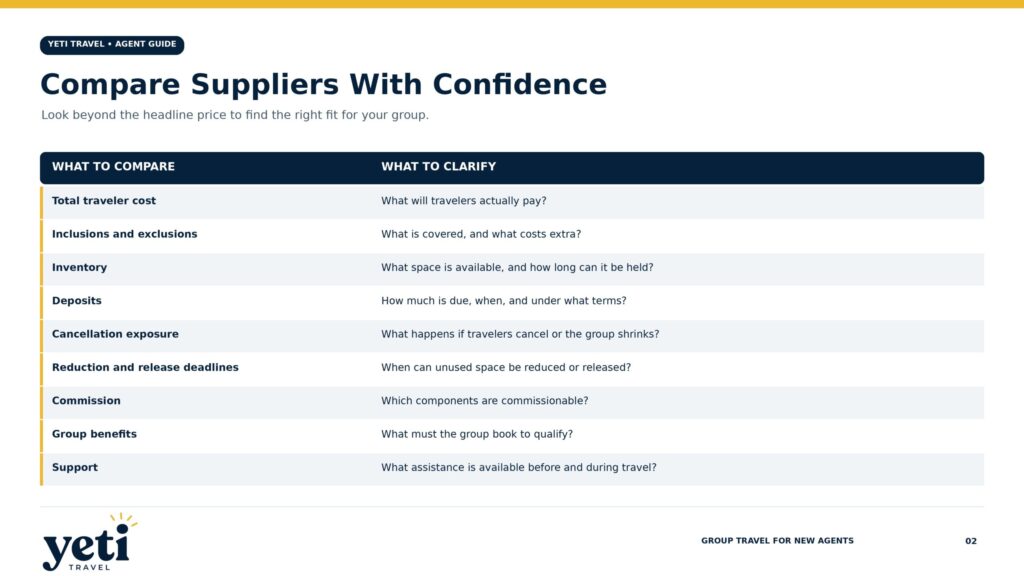
The lowest advertised price might include conditions that are hard for your group to meet.
Ask About Accessible Arrangements Early
Find out early if anyone in your group needs a specific room setup, help with mobility, or special transportation. Don’t wait until the last payment to learn about these needs.
Get written confirmation from the supplier about any special arrangements. Don’t promise accessibility features just because they are mentioned in a general description.
Plan based on what the traveler really needs, not just on your own idea of what “accessible” means.

7. Understand Group Contracts Before Anyone Signs
At this stage, group travel is more like managing a business than simply planning a vacation.
Group agreements may cover room inventory, deposits, payment schedules, cancellation terms, concessions, and penalties for failing to use contracted space.
Make sure you know what these terms mean before you agree to anything.
Room Block
A room block means a certain number of rooms are set aside for your group under specific conditions.
Ask:
- How many rooms are being held?
- Which categories are included?
- How long does the hold last?
- Is a deposit required?
- What happens to unsold rooms?
- Who is financially responsible?
Remember, a courtesy hold and a formal room contract are not the same thing.
Attrition
Attrition rules explain what happens if your group uses fewer rooms than you agreed to in the contract.
The language in these rules can be confusing. Instead of just accepting terms like “20% attrition,” ask the supplier to spell out the minimum number of rooms you must use and how any penalties would be figured out.
For example, if your contract says you must use 16 out of 20 rooms, but you only fill 14, you could face extra charges.
However, the exact amount you owe depends on how the contract calculates it, not just on how many rooms are empty.
Cutoff Date
A cutoff date is when any rooms your group hasn’t booked can be released. After this date, prices or availability might change.
Keep the cutoff separate from:
- Deposit dates.
- Final payment.
- Rooming-list deadlines.
- Cancellation deadlines.
These dates are often different from each other.
Cancellation Terms
Find out what happens if:
- One traveler cancels.
- The organizer withdraws.
- The group shrinks.
- The entire trip is canceled.
- A supplier changes arrangements.
Check with your host agency to find out who is allowed to sign contracts and when you should get a legal review.
Don’t assume you can sign on behalf of the agency, or that the organizer’s signature covers all agency responsibilities.

8. Price the Trip for Profit, Not Just Sales
Having a full schedule might make it easy to overlook if your service is priced too low.
Travel advisors can earn money through supplier commissions, by charging planning or coordination fees where allowed, or by combining both methods.
When setting prices for group trips, remember to include:
- Platform costs.
- Marketing.
- Payment processing.
- Hosting responsibilities, when applicable.
Understand What Your Commission Applies To
Avoid figuring your income by simply applying your commission rate to the total amount travelers spend.
Ask:
- Which components are commissionable?
- What rate applies?
- When is payment expected?
- What deductions apply?
- How does your agency split work?
- What happens if travelers cancel?
A Hypothetical Earnings Example
Suppose you book 10 rooms:
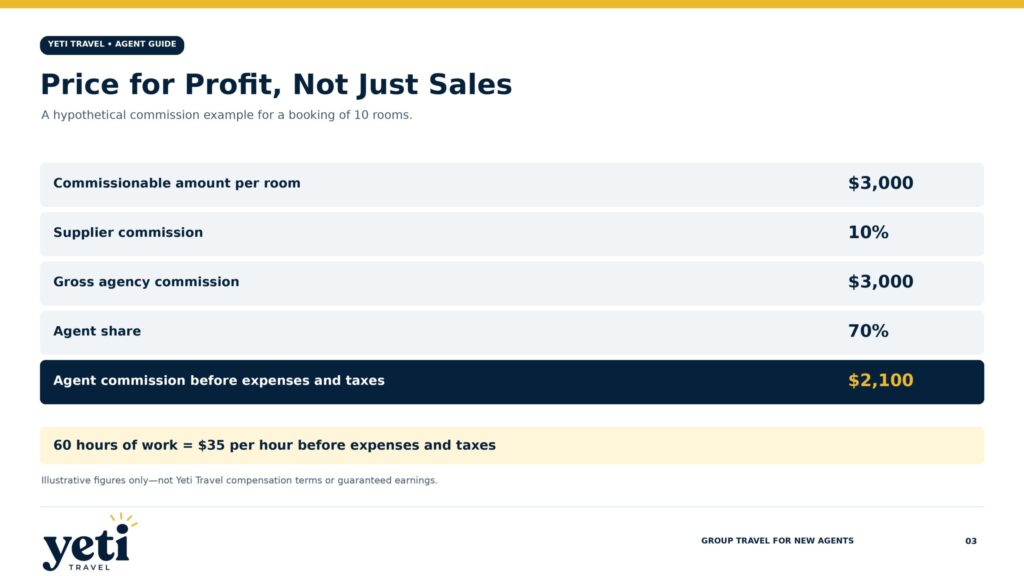
These numbers are just examples. They do not represent Yeti Travel’s actual compensation terms or guarantee any earnings.
Next, think about how many hours you plan to work. For example, if you expect to work 60 hours, your commission would be about $35 per hour before expenses and taxes.
This hourly rate is a more helpful number for planning than just looking at the total booking value.
Decide on Your Minimum Group Size
Before you launch, make sure to define the following:
- The smallest group size needed to qualify for supplier benefits.
- The minimum number of travelers you need to cover your costs.
- The deadline for deciding if the trip will go ahead.
- What you will tell travelers if you do not reach the minimum group size.
Make sure to keep the supplier’s eligibility rules separate from your own business needs and your decision deadline.
A trip can qualify for a supplier program and still fail your business test.

9. Handle Group Payments Without Creating Confusion
Managing payments well begins even before you collect the first deposit.
Make sure each traveler understands the following:
- Amount due.
- Due date.
- What the payment secures.
- Refundability.
- Cancellation terms.
- How payment will be processed.
- When a reservation becomes confirmed.
Follow your agency’s approved booking and payment steps. Always make sure charges to customer accounts are properly authorized.
Keep individual traveler payments separate whenever the booking structure allows it. One organizer collecting everyone’s money can create extra confusion about who paid, what was authorized, and who receives a refund.
Give Yourself a Deadline Buffer
When you can, set traveler deadlines a bit earlier than your supplier’s deadlines. This gives you extra time to handle declined payments, missing authorizations, or unanswered messages.
Be honest about your deadlines. Don’t tell travelers your internal deadline is the same as the supplier’s official deadline.
Track Confirmed Bookings—Not Promises
Use distinct stages:
1. Interested.
2. Quoted.
3. Deposit submitted.
4. Supplier confirmed.
5. Paid in full.
6. Travel-ready.
If someone says “We’re in!”, it doesn’t always mean they’ve actually booked.
Keeping these stages separate helps you see a clearer, more accurate picture of the group.

10. Build One Reliable System for Group Details
When you manage group travel, you have to keep track of rooming lists, special requests, payments, and deadlines. Booking platforms can make this easier by sending reminders and helping you organize communication with travelers.
Your system does not need to be complicated, but it should always be consistent.
Maintain one working record for:
- Traveler names.
- Booking references.
- Room assignments.
- Payment status.
- Supplier deadlines.
- Confirmed requests.
- Outstanding questions.
- Protection decisions.
- Emergency contacts.
Make sure you use tools approved by your agency and keep sensitive information secure. Avoid using public spreadsheets or group chats to store things like passport details or payment information.
Create a Simple Communication Map
Give each channel one job:
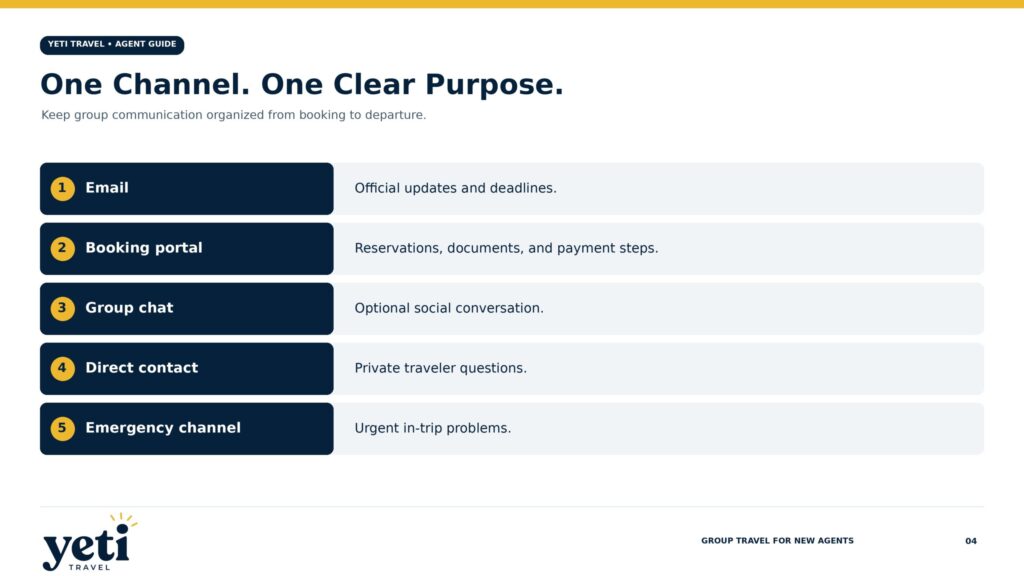
When too much is happening at once, it’s easy to miss important details.

11. Give the Group Leader a Clear Role
A strong organizer keeps things moving forward.
However, being the group leader does not mean taking on all the customer service work for free.
Make sure everyone knows their responsibilities.
The Agent’s Role Might Include
- Supplier coordination.
- Booking instructions.
- Payment reminders.
- Reservation questions.
- Travel-document guidance.
- Changes within the agreed service scope.
The Leader’s Role Might Include
- Introducing the trip.
- Encouraging timely decisions.
- Sharing approved announcements.
- Gathering preferences.
- Helping build excitement.
Let travelers know which issues they should bring straight to you. For example, requests like changing a legal name or canceling a reservation should not be relayed through several people.

12. Explain Group Perks Without Promising a Free Vacation
Group perks can be attractive, but they depend on the specific program.
Princess’s Celebration Group Program, for example, describes tour conductor credits tied to qualifying stateroom bookings and offers ways to adjust the earning ratio through its points structure.
The key point is that a tour conductor credit does not always mean a completely free trip.
Before advertising a benefit, verify:
- What earns it.
- How its value is calculated.
- Whether it applies to a berth, room, credit, or another benefit.
- What charges remain.
- Whether cancellations affect eligibility.
- Who receives it.
Write down how you plan to use any organizer benefits you agree on.
You may be able to use a credit for the leader’s fare or another approved use, but wait for the supplier to confirm the rules before making any promises.

13. Plan the Experience, Not Just the Reservations
Here’s a helpful way to approach group itineraries: focus on planning key moments instead of trying to keep everyone together all the time.
An anchor is a shared experience that helps define the trip.
For a Family Theme-Park Vacation
Shared anchors might include:
- A welcome dinner.
- One group photo.
- A shared attraction plan.
- An evening celebration.
For a Cruise
Shared anchors might include:
- A sailaway meetup.
- A group dinner.
- An optional excursion.
- A farewell gathering.
This is just a planning suggestion, not a rule from any travel provider.
This way, you give everyone chances to connect without making them stick to the same schedule.
Build in “Permission to Opt Out”
Let travelers know which activities are:
- Included and scheduled.
- Optional and extra.
- Informal meetups.
- Free time.
A grandparent, a toddler, and a teenager who loves adventure might all enjoy the same trip, but for different reasons.
Your plan should allow for those differences.

14. Discuss Travel Protection and Disruptions Early
Traveling as a group doesn’t take away individual travel risks.
If someone gets sick, misses a connection, or has a family emergency, it might change their plans but not the whole group’s.
Travel disruption insurance, travel health insurance, and medical evacuation insurance each cover different things. You can sometimes buy them together or separately.
Ask travelers to look over:
- Covered cancellation reasons.
- Trip interruption.
- Emergency medical coverage.
- Medical evacuation.
- Travel delays.
- Exclusions and limitations.
- Time-sensitive purchase requirements.
Don’t guarantee that a claim will be paid. For questions about coverage, send travelers to the insurance company or a qualified professional.
Travelers should also find out if their health insurance works in other countries and get extra coverage if needed.
Make a Plan for Travel Disruptions
Before departure, answer:
- Who does a delayed traveler contact?
- Who handles supplier emergencies?
- What if someone misses the group transfer?
- Where are confirmed meeting instructions?
- What assistance is available outside business hours?
A group chat can help, but it’s not a full emergency plan.

15. Follow a Practical Timeline for Your First Group Trip
There isn’t one perfect timeline for planning. The best schedule depends on things like available spots, contracts, where you’re going, and how much time travelers need to decide.
It’s more important to follow the right steps than to use the same dates as someone else.
Stage 1: Qualify the Idea
- Confirm the purpose.
- Identify the organizer.
- Test the budget.
- Estimate likely bookings.
- Review your agency’s procedures.
Stage 2: Source and Review
- Request comparable proposals.
- Check availability.
- Review contract exposure.
- Confirm pricing and benefits.
- Establish a proceed-or-cancel decision point.
Stage 3: Launch Bookings
- Publish one clear trip description.
- Explain inclusions and exclusions.
- Provide approved payment instructions.
- Share cancellation terms.
- Track confirmed reservations.
Stage 4: Prepare Travelers
- Reconcile names and room assignments.
- Review outstanding balances.
- Confirm supplier arrangements.
- Provide destination-specific document guidance.
- Hold a pre-departure briefing.
Stage 5: Close the Loop
- Reconcile your earnings and expenses.
- Ask for feedback.
- Request permission to use testimonials or photos.
- Note what caused confusion.
- Discuss future travel only after understanding how this trip went.

Common Mistakes New Group Travel Agents Should Avoid
Holding Space Based on Enthusiasm Alone
Just because people seem interested does not mean they will actually pay and join the group.
Make sure the group has the budget and is ready before you take on any financial risk.
Promising the Lowest Price
Group arrangements can offer benefits such as ticketing flexibility or coordinated services. American Airlines, for example, lists flexible ticketing and a name-change benefit within its group offering.
Focus on the real benefits of the group offer. Remember, group deals do not always beat every individual promotion.
Offering Unlimited Coordination
Define what your service includes.
- Does it cover one itinerary revision or ten?
- Are you arranging every optional dinner?
- Will you travel with the group?
If you are not clear about what is included, a simple booking can quickly become a never-ending project.
Letting the Loudest Traveler Redesign the Trip
Make sure everyone agrees on the main details of the trip before you start planning.
One person’s preferences shouldn’t quietly replace the experience everyone else purchased.
Ignoring Business and Insurance Requirements
Check with your host agency to find out which registrations, rules, fees, contracts, and insurance you need for your business and each booking.
Make sure you know exactly what your errors and omissions insurance covers. Do not assume it includes every group activity or hosted trip.

FAQ: Group Travel for New Agents
How Do I Become a Group Travel Agent?
Begin by getting to know your agency’s booking steps, picking a group type that fits you, and learning how supplier contracts work. Next, find a real group, look for good options, and set up a clear process for payments, reservations, and communication.
As a group agent, your job covers things like managing room blocks, meeting deadlines, handling rooming lists, and working with contracts. It’s much more than just picking destinations.
How Many People Qualify for Group Travel?
The answer depends on the supplier and the program. For example, American Airlines lets you book group travel for 10 or more people, while Princess’s Celebration Group Program has requirements based on the number of staterooms.
Always check the latest rules for the specific product you want to offer.
How Do Group Travel Agents Make Money?
Most group travel agents earn money from supplier commissions and, where allowed, from planning or coordination fees that are shared with the client.
How much you earn depends on your commissionable sales, your agency’s agreements, your expenses, and what services you provide.
Is Group Travel Always Cheaper?
Not always. Be sure to compare the total package, including price, what’s included, flexibility, and support.
Some group programs focus on perks like flexible ticketing instead of always offering the lowest price.
What Is the Difference Between an Affinity Group and a Speculative Group?
An affinity group is made up of people who already have something in common, like being family or part of the same club.
A speculative group starts with a trip that the agent designs and advertises, usually before knowing who will actually sign up.
Do Travel Agents Have to Accompany Their Groups?
Not always. Think about whether you’re just handling the bookings or if you want to travel with the group and host the trip.
If you decide to go with the group, make sure you clearly explain your role and what you’ll do on-site. Don’t forget to include your travel costs, work at the destination, and the time you’ll spend away from other clients.
What Is a Tour Conductor Credit?
A tour conductor credit is a group benefit set by the supplier that you earn when you meet certain booking requirements. The value and how you can use it will depend on the supplier.
Don’t call it a totally free vacation unless the supplier’s rules truly allow for that.
What Happens If a Group Doesn’t Fill?
What happens next depends on your agreement. Unused rooms or spots might be released, you could lose some benefits, or there might be penalties.
Before you commit, check the minimum group size, deadlines for reducing numbers, cancellation policies, and what happens if people drop out.
Should I Collect One Payment From the Group Leader?
Stick to your agency’s process and make sure you meet the supplier’s requirements.
If individual payments are allowed, it can make it easier to keep track and get the right approvals. No matter how you collect payments, always make sure charges are properly authorized.
Can I Book Theme-Park Vacations for Groups?
You can plan a group trip to a theme park, but don’t expect your group to automatically get special ticket prices or group perks.
Check the latest ticket, hotel, dining, transportation, and booking rules for the trip before you give a quote.
What’s the Best First Group for a Beginner?
Pick a group that already exists, has a clear goal, a realistic budget, a reliable organizer, and isn’t too complicated to manage.
Aim for a trip you can handle well, not just the largest group you can convince to ask about your services.

Your First Group Doesn’t Have to Be Huge to Matter
Group travel means bringing people together and making sure the details don’t get in the way.
Begin with a group you know well. Ask clear questions. Check the terms before getting excited about the perks. Value your time, explain the rules, and show travelers exactly how to go from “That sounds fun” to “We’re booked!”
The best part isn’t just filling rooms. It’s helping people finally take the trip they’ve been dreaming about, and then creating a business process you can trust and use again!